
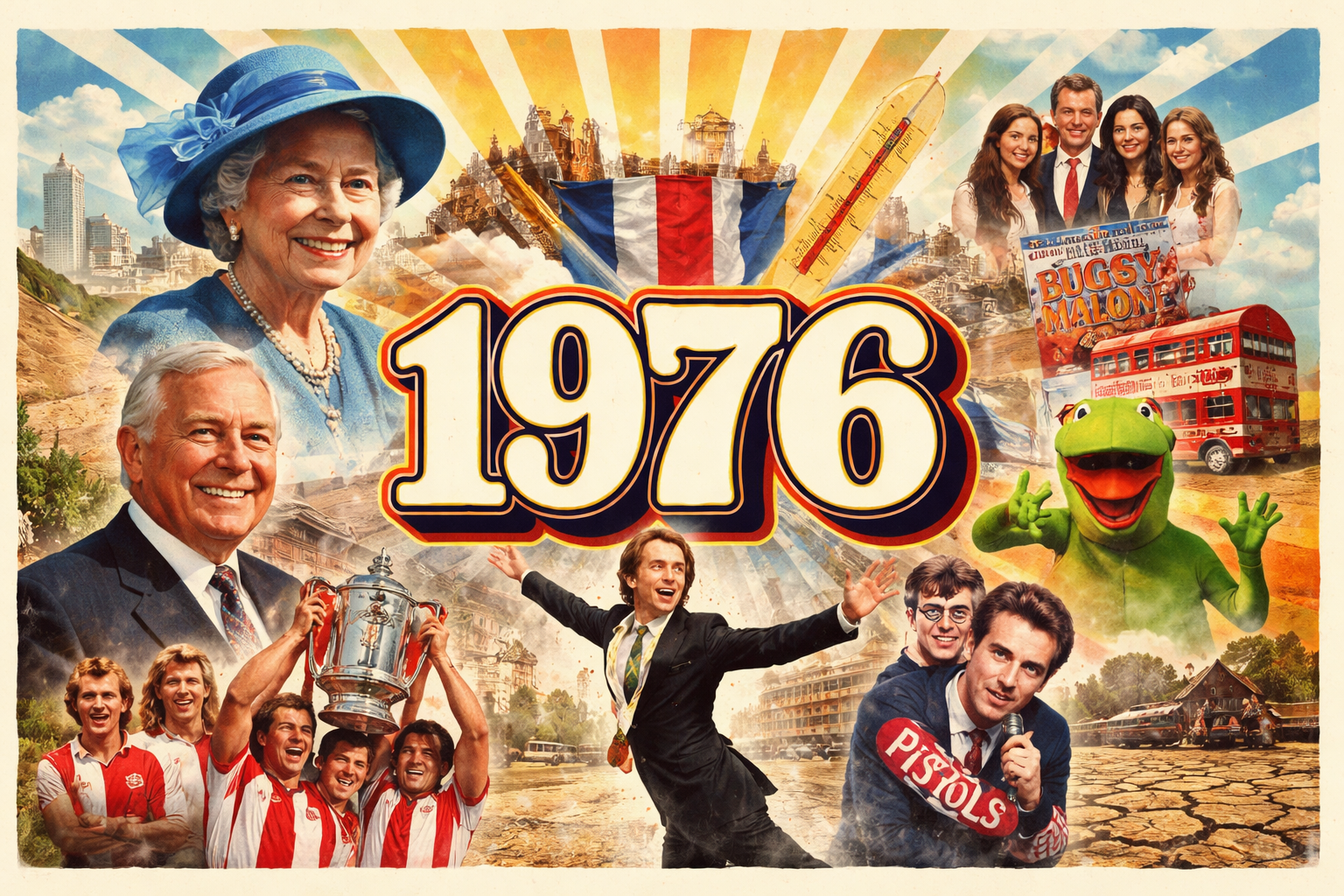
In 2026, we mark the 50th anniversary of the year 1976.
Table of Contents
What Happened in 1976 in the UK?
1976 stands out as one of the most memorable years of modern British history. On it’s 50th anniversary, it is recalled for political change at the top, extreme summer weather, economic strain, sporting triumphs, and the cultural sparks that would shape Britain for decades. From a heatwave that parched the landscape to the first stirrings of punk, 1976 left an imprint that still resonates today.
Throughout the year, the United Kingdom remained under the reign of Elizabeth II, who was monarch for the entirety of 1976. Political leadership, however, changed dramatically in the spring. Harold Wilson served as Prime Minister until 5th April, when he resigned unexpectedly. On the same day, James Callaghan succeeded him, becoming the new Labour Prime Minister at a time of growing economic and political pressure.
The Great Clock of Westminster ( Big Ben ) Suffers internal damage on 5th August and stops working for over nine months.
Major Events of the Year 1976 in the UK
January to April
The year began with moments of national pride and international attention. On 2nd February, the Queen officially opened the National Exhibition Centre in Birmingham, marking a major addition to the UK’s exhibition and events infrastructure. Just days later, from 4th to 15th February, Great Britain and Northern Ireland competed at the Winter Olympics in Innsbruck. The standout achievement came on 11th February, when John Curry became Britain’s first Olympic gold medallist in figure skating.
Royal life also made headlines when Princess Margaret and Lord Snowdon announced their separation on 19th March, bringing an end to 16 years of marriage. Political change followed soon after, with James Callaghan taking over as Prime Minister on 5th April. Later that month, the nation was shocked when actor Sid James collapsed and died on stage at Sunderland Empire Theatre on 26th April.
May to August
Early May brought sporting celebration. On 1 May, Southampton FC claimed a famous FA Cup victory at Wembley, defeating Manchester United 1–0. Just three days later, Liverpool FC secured the Football League First Division title.
As summer arrived, Britain experienced one of its most extreme weather events. From late June through August, the British Isles were gripped by an intense heatwave and drought. On 3rd July, temperatures peaked at 35.9°C in Cheltenham, contributing to what became one of the driest and hottest summers on record.
Amid the heat, a cultural shift was quietly gaining momentum. On 4th July, early gigs and releases by bands such as the Sex Pistols, The Clash and The Damned signalled the ignition of the UK punk movement.
September to December
Television history was made on 5th September when The Muppet Show premiered on ITV, quickly becoming a family favourite. Around early September, the Labour government faced mounting economic difficulties and sought support from the International Monetary Fund, as inflation and pressure on sterling intensified. Earlier in the year, the political mood had already been tested at the local elections on 6th May, when Conservative gains came at the expense of Labour across councils in England and Wales.
Notable Publications of the Year
Nineteen seventy-six was a remarkable year for British publishing. Richard Dawkins released The Selfish Gene, a work that would go on to influence scientific thought for generations. Fiction readers were drawn to Not a Penny More, Not a Penny Less by Jeffrey Archer, while Kingsley Amis published The Alteration. New voices also emerged, with Terry Pratchett releasing his first novel, The Dark Side of the Sun. The year also marked the publication of Sleeping Murder, the final Miss Marple story by Agatha Christie, released posthumously.
Popular Culture in 1976
UK Music of 1976
On 4th April, Brotherhood of Man won the Eurovision Song Contest with “Save Your Kisses for Me”, giving the UK a major international success.
At the same time, the foundations of a musical revolution were being laid. Bands including The Jam, The Cure and Madness formed in 1976, alongside other punk pioneers, reshaping British music.
Singles of the Year
As 1976 unfolded, the UK singles chart reflected both continuity and change. The year began at No. 1 with “Bohemian Rhapsody” by Queen, which had already topped the charts at the end of 1975 and continued its record-breaking run into January, making it the chart-topper as the year opened. At the other end of the calendar, 1976 closed with “When a Child Is Born (Soleado)” by Johnny Mathis, a seasonal release that held No. 1 through the final weeks of December and into early 1977. The single that dominated 1976 overall was “Save Your Kisses for Me” by Brotherhood of Man, which spent six weeks at No. 1 during the year — the longest cumulative run at the top in 1976 — helped significantly by its victory at the Eurovision Song Contest, which propelled it to sustained chart success.
Overall ABBA dominated this year with three number ones, their four singles all entered a top 10 spot initially and remained in the top 10 of the charts for a total of 30 weeks.
Top 5 Best-Selling Singles in the UK (1976)
- Save Your Kisses for Me – Brotherhood of Man
- UK chart position: No. 1
- Notable detail: Winner of the 1976 Eurovision Song Contest
- Significance: The best-selling single of the entire year in the UK
- Don’t Go Breaking My Heart – Elton John & Kiki Dee
- UK chart position: No. 1
- Notable detail: Elton John’s first UK number-one single
- Significance: One of the decade’s most successful duets
- Dancing Queen – ABBA
- UK chart position: No. 1
- Notable detail: ABBA’s 3rd number one single this year.
- Significance: One of the most enduring pop songs of the 1970s
- A Little Bit More — Dr. Hook
- UK chart position: No. 1
- Notable detail: It reached number two on the UK Singles Chart in July 1976 for five consecutive weeks, being held from the top spot by Elton John and Kiki Dee’s
- Significance: It was Dr. Hook’s joint second-best UK chart placing, matching their song “Sylvia’s Mother” and surpassed only by “When You’re in Love with a Beautiful Woman”.
- Mississippi – Pussycat
- UK chart position: No. 1
- Notable detail: Spent four weeks at the top of the UK chart
- Significance: One of the most successful European pop imports of the year
UK Television of the Year 1976
British television enjoyed a strong year. Ripping Yarns began airing on 7th January, followed by the debut of Open All Hours on 20th February. Later in the year, on 20th September, the acclaimed historical drama I, Claudius was first broadcast, quickly earning a reputation as one of the finest British television productions.
Top UK Movies of 1976
UK cinema audiences were treated to a varied slate of releases. British actor Omar Sharif appeared in Ace Up My Sleeve, a UK co-production. Other notable British films released during the year included Bugsy Malone, Aces High, Adventures of a Taxi Driver and Carry On England.
Cinema goers were treated to some classic horror in the shape of The Omen and a classic sequel with The Pink Panther Strikes Again. The top 3 grossing fims in the UK in this year were 1. Jaws, 2. One Flew Over The Cuckoos Nest. 3. Disney’s The Jungle Book.
British films of 1976: including Bugsy Malone, Carry On England and Adventures of a Taxi Driver
Economy and Society
Economic challenges were a defining feature of 1976. The UK faced severe currency and balance-of-payments pressures, culminating in a major request for an IMF loan in the autumn, valued at £2.3billion. Inflation remained high, running at 16.5% it peaked in this year at 24%, linked to the wider sterling crisis and lingering effects of the 1973 oil shock. Daily life reflected these conditions: the average house price stood at around £12,704, the typical weekly wage was about £72, and a pint of beer cost roughly 32p. Political dissatisfaction surfaced in the local elections on 6th May, where Conservative gains highlighted growing unease with the Labour government.
| Item | Price in 1976 | Price in 2024 | Notes |
|---|---|---|---|
| Loaf of Bread (800g) | £0.19 | £1.35 | Basic white loaf, subsidized in ’76 versus market price now. |
| Pint of Milk | £0.09 | £0.85 | Delivered in glass bottles in 1976; supermarket price today. |
| Dozen Eggs | £0.43 | £2.30 | Standard medium eggs, a staple kitchen item. |
| Litre of Petrol | £0.17 | £1.65 | Equivalent to ~77p per UK gallon in 1976; fuel duties add to modern cost. |
| Pint of Bitter (beer) | £0.33 | £4.25 | Pub pint; prices vary regionally, rise reflects inflation and duty. |
| Average House Price | £12,704 | £295,000 | UK national average house price. |
| Average Annual Salary | ~£3,750 | £33,000 | Approx. full-time average; shows income growth 1976–2024. |
Sporting Highlights
Winter Olympics – Figure skater John Curry won Olympic gold for Great Britain on 11 February at the 1976 Winter Games in Innsbruck. His elegant performance earned Britain its first-ever gold medal in figure skating.
Football – Southampton FC’s surprise FA Cup triumph on 1 May was followed on 4 May by Liverpool FC clinching the First Division league title. Liverpool also won the UEFA Cup in 1976, completing a notable double and underlining English clubs’ strength in Europe.
Formula One – Britain’s James Hunt clinched the 1976 Formula One World Championship, dramatically winning the title by one point. Hunt’s rivalry with Niki Lauda (who survived a near-fatal crash that year) became legendary in motor sport.
Tennis – British player Sue Barker won the French Open Women’s Singles title in June 1976. This marked a rare Grand Slam victory for the UK, and she remains the last British woman to win the French Open.
Rugby & Cricket – Wales dominated the Five Nations Championship (grand slam in 1976), confirming their 1970s rugby prowess. In cricket, the West Indies toured England: Viv Richards scored 291 in a Test at The Oval as West Indies won the series, a sobering defeat that spurred England to re-evaluate training and tactics.
Births in 1976
- 21st January – Emma Bunton, pop singer (Spice Girls)
- 8th February – Abi Titmuss, television presenter and model
- 23rd March – Chris Hoy, Olympic gold medal-winning cyclist[47]
- 18th April – Sean Maguire, actor and singer
- 8th May – Ian “H” Watkins, pop singer (Steps)
- 14th May – Martine McCutcheon, actress and singer
- 6th June – Ross Noble, comedian
- 14th June – Alan Carr, comedian and broadcaster
- 6th July – Chris Philp, politician
- 8th July – Ellen MacArthur, yachtswoman
- 12th July – Anna Friel, actress
- 13th July – Lisa Riley, actress and television presenter
- 14th July – Geraint Jones, cricketer
- 19th July – Benedict Cumberbatch, English actor
- 15th September – Paul Thomson, drummer (Franz Ferdinand)
- 16th September – Tina Barrett, singer (S Club 7)
- 23rd October – Cat Deeley, television presenter
- 12th December – Dan Hawkins, rock guitarist (The Darkness)
Deaths During the Year
The year also brought the loss of several notable figures. On 5th January, Mal Evans, closely associated with The Beatles, died. Literary Britain mourned Agatha Christie on 12th January. Artist L. S. Lowry died on 23rd February, followed by Field Marshal Bernard Montgomery on 24th March. Novelist Richard Hughes died on 28th April, actor George Curzon on 7th May, and actress Sybil Thorndike on 9th June. The year closed with the death of composer Benjamin Britten on 4th December.
Marriages in 1976
Some notable people were married this year.
- 23rd January- Sidney Poitier (American Actor) marries Joanna Shimkus (Canadian Actress)
- 20th March- Alice Cooper (American Rocker) marries Sheryl Goddard (Choreographer)
- 14th April- Doris Day (Singer and Actress) marries Barry Comden (Restaurateur)
- 1st May- Sting (British Singer) marries Frances Tomelty (Actress)
- 11th July- Andy Gibb (British Pop Singer) marries Kim Reeder
- 11th July- Frank Sinatra (Singer and Actor) marries Barbara Marx (American Socialite)
- 4th December- Elizabeth Taylor (Actress) marries John Warner (American Politician)
Anniversaries in 1976
- Alfred Hitchcock and Alma ( nee Reville) celebrated their Golden Wedding on 2nd December.
- Paul Henreid and Elizabeth Camilla Julia ( nee Gluck) celebrated their Ruby Wedding on 1st January.
- Jimmy Carter and Rosalynn ( nee Smith) celebrated their Pearl Wedding on 7th July.
- Margaret Hilda ( nee Roberts) and Denis Thatcher celebrated their Silver Wedding on 13th December.
Other Notable anniversaries
It has been 50 years since some major events happened.
- On the 26th January 1926 John Logie Baird gave the first public demonstration of television in his London laboratory.
- On the 7th March 1926 the first transatlantic test telephone call (London to New York) was made, a year later the service started.
- On 28th June 1926 Mercedes-Benz formed when the world’s oldest automobile manufacturers DMG and Benz and Cie merge.
- On 14th October 1926 A.A. Milne’s book ‘Winnie the Pooh’ was published.
Gift Ideas for 1976
-

1976 The Story of Your Year 50th Anniversary Booklet CD and Music Download
£11.95 -
1976 Your Special Year DVD Greeting Card — 50th Birthday Card
£3.95 -
DVD Greeting Card, The Time of your Life -1976
£10.95 -
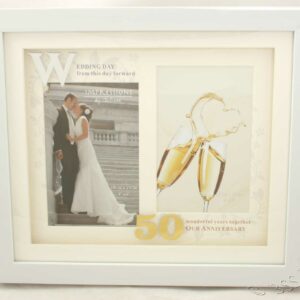
50th Wedding Anniversary White Photo Frame Then & Now
Original price was: £17.95.£7.49Current price is: £7.49. -
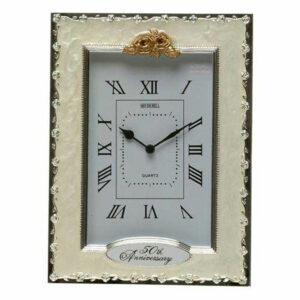
Celebration Golden Wedding 50th Anniversary Clock
£22.95 -
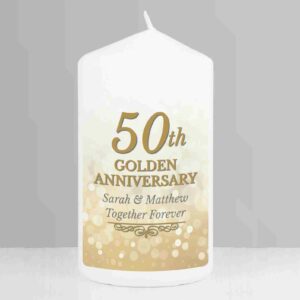
50th Golden Anniversary Pillar Candle, free personalisation
£13.99 -
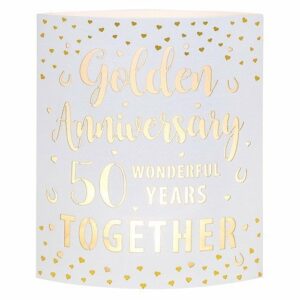
Golden Anniversary – 50 Wonderful Years Together Starlight LED Lantern
Original price was: £8.95.£5.95Current price is: £5.95. -
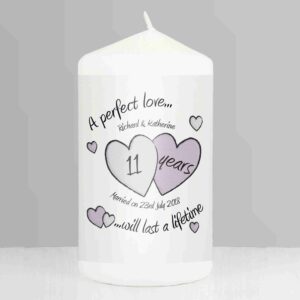
A Perfect Love Anniversary Pillar Candle, free personalisation
£14.95
Check Amazon’s list of 1976 Gift Ideas for women or 1976 gift ideas for men
Looking for the perfect present inspired by this unforgettable year? Whether you’re buying for a birthday, anniversary or milestone celebration, it’s worth exploring Amazon’s list of 1976 gift ideas for women or 1976 gift ideas for men. From nostalgic keepsakes and retro-style accessories to personalised mementos marking the year 1976, these curated collections make it easy to find thoughtful gifts that reflect the spirit of the time and the significance of turning 50.
50 years on, 1976 remains a year of striking contrasts — hardship and creativity, drought and cultural renewal. It was a year that challenged Britain, but also one that quietly reshaped its future.
