
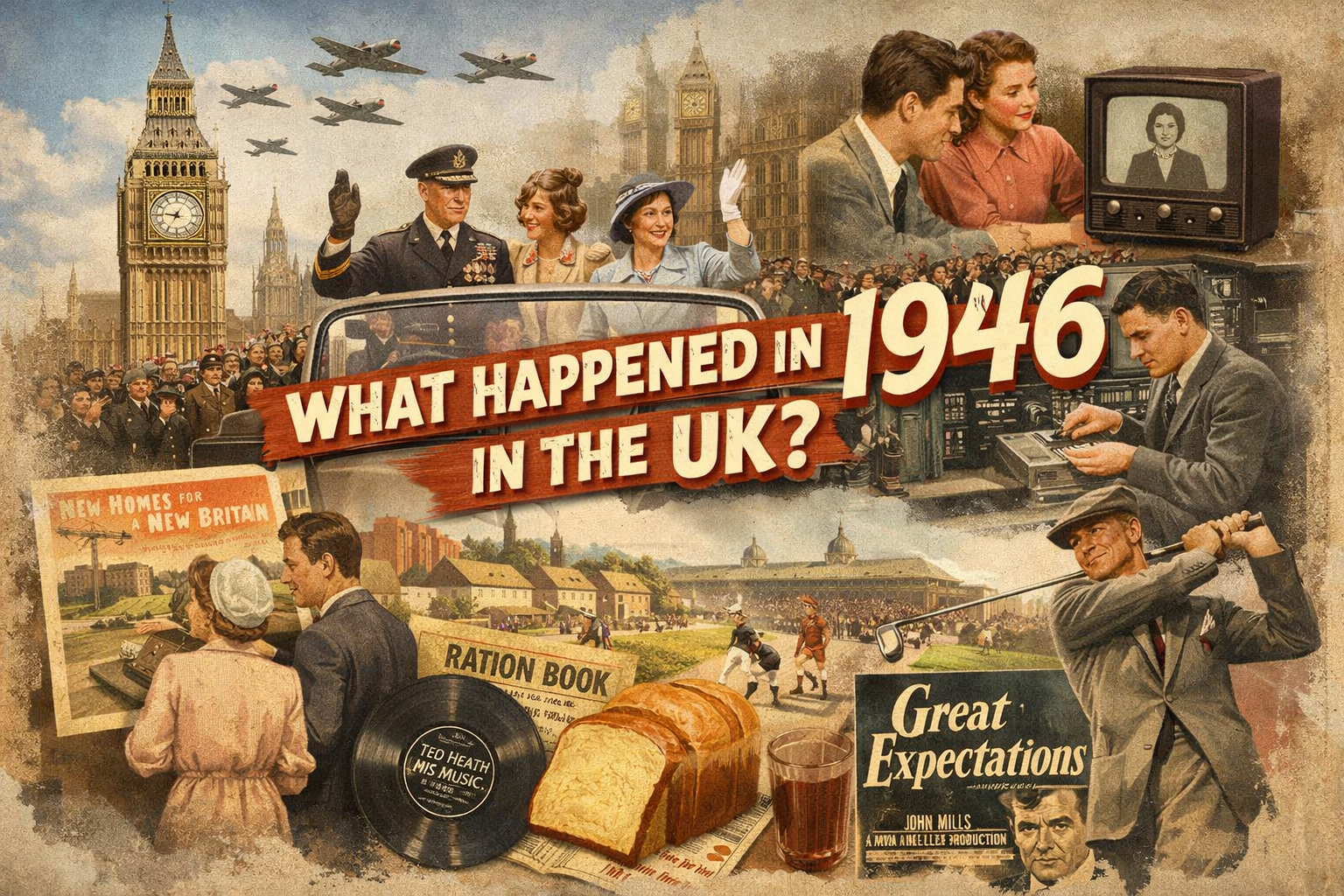
In 2026, we mark the 80th anniversary of 1946 — a year when Britain was learning how to live in peacetime again, even while daily life still felt shaped by wartime rules.
If you were born in 1946, you’re celebrating your 80th birthday this year; if you married in 1946, it’s your (80th) wedding anniversary. It was a year of rebuilding and readjustment, with moments of pride on the streets and tough choices at the top. Join us as we revisit what made 1946 such a defining year in the UK.
Table of Contents
Major events of 1946 in the UK
14 February 1946 – Bank of England nationalised: The Bank of England was taken into state control, a major early move in the Labour government’s programme of public ownership.
25 February 1946 – Civil aviation reorganised: Civil aviation was reshaped under state-owned corporations, with British European Airways formed after the civil aviation nationalisation bill.
March 1946 – Transjordan independence: Britain granted Transjordan independence, one sign of the wider post-war shift in Britain’s global role.
31 March 1946 – London Heathrow Airport: The airport was opened fully for civilian use.
15 July 1946 – Anglo-American Loan agreed: On 15th July 1946, the UK secured a $3.75 billion US loan (about £1 billion at the time) at 2% interest. Negotiated by John M. Keynes, it supported recovery and came with conditions including sterling–dollar convertibility.
21 July 1946 – Bread rationing begins: From 21st July 1946, bread, flour and flour products were rationed — Britain’s first-ever bread rationing, driven by global wheat shortages and widely criticised at home.
1 August 1946 – National Insurance Act 1946 receives Royal Assent: On 1st August 1946, the National Insurance Act 1946 became law, creating a universal compulsory insurance system for pensions, unemployment, and sickness.
1 August 1946 – New Towns Act 1946 receives Royal Assent: On 1st August 1946, the New Towns Act 1946 was passed to create planned communities to tackle the housing shortage. Stevenage was designated the first “New Town” in 1946.
6 November 1946 – National Health Service Act passed: On 6th November 1946, legislation was passed to establish the National Health Service from 1948, with planning and investment beginning in anticipation.
8 June 1946 – Victory Parade in London: On 8th June 1946, a major Victory Parade brought huge crowds into central London to celebrate the end of WWII, with the royal family and government joining the national moment.
Summer 1946 – Pontins opens: Fred Pontin opens the first Pontins Holiday Camp in Brean Sands, Somerset, on a former US Army base built during World War II.
Global events that happened in 1946
- March 1946 – Churchill’s “Iron Curtain” speech: Winston Churchill’s speech in Fulton (USA) signalled the emerging Cold War, with Britain aligning with the US in wariness of Soviet intentions.
- February 1946 – Palestine plan proposed: The UK proposed a five-year plan for Palestine in February, reflecting the strain and negotiation surrounding Britain’s Middle Eastern responsibilities.
- 1946 – Mounting pressure toward Indian independence: In India, provincial elections and rising pressure indicated independence was imminent (achieved in 1947), part of wider colonial transitions.
UK music of 1946
Music in 1946 still carried the sound of the pre-war and wartime years — sentimental ballads, big bands, radio variety, and crowded dance halls. Skiffle and rock ’n’ roll were still a few years away, so the nation’s soundtrack leaned toward crooners, orchestras, and familiar favourites.
The popular songs and performers
Because the official UK record charts began in 1952, 1946 had no formal “number one” singles. Popularity was measured through sheet music sales and BBC radio play. Among the year’s most popular numbers were “Bless ’Em All” and Frank Sinatra’s renditions of “Five Minutes More” and “South America, Take It Away”.
Britain’s dance band era was in full swing, with Ted Heath and His Music and Joe Loss’s Orchestra filling ballrooms. On radio, voices such as Vera Lynn (the “Forces’ Sweetheart”) and Dickie Valentine remained popular, while Eddie Calvert (pianist) and Anne Shelton (vocalist) were frequently heard on the BBC.
Classical highlights
The first post-war Henry Wood Promenade Concerts (Proms) were held in summer 1946 under new BBC management, featuring British composers such as Ralph Vaughan Williams and William Walton. In April 1946, Vaughan Williams premiered his Symphony No. 5 in London to great acclaim. The London Philharmonic and the Hallé Orchestra (under Sir John Barbirolli) resumed full seasons as concert life revived.
Records and radio
Shellac 78 RPM records remained the format, and production was limited by raw-material shortages. The BBC Light Programme (launched 1945) did much of the heavy lifting for music broadcasting — and in November 1946, the BBC began experimenting with FM radio for higher-fidelity music transmission in London trials.
Top UK movies of 1946
British cinema in 1946 offered grand literary adaptations, imaginative storytelling, and the continued pull of Hollywood imports — all while the public made the most of cinema-going as a shared escape.
- Great Expectations: David Lean’s Dickens adaptation, released December 1946, starring John Mills with Alec Guinness, became a critical and commercial hit and won Best British Film at the 1947 BAFTAs.
- A Matter of Life and Death: Released in the UK in 1946, Powell and Pressburger’s fantasy-romance starred David Niven as a RAF pilot facing a heavenly trial, celebrated for its bold style and colour.
- Brief Encounter: Released in late 1945 but still hugely popular in 1946, the film struck a chord with audiences and won the Grand Prize at Cannes in 1946.
- Ealing’s post-war direction: In 1946, Ealing’s early post-war comedies began production — including Hue and Cry (filmed in 1946 for release in 1947) — while Dead of Night (1945) continued influencing the genre.
- Hollywood imports: American films dominated the UK box office. UK releases in 1946 included The Bells of St. Mary’s (Bing Crosby) and Disney’s Song of the South, plus Hitchcock’s Notorious and the noir The Blue Dahlia. Many cinemagoers used their weekly cinema rations under the quota system for film imports.
Science & technology in 1946
If 1946 was about rebuilding homes and lives, it was also about turning wartime ingenuity into peacetime progress — with television, medicine, and computing each taking meaningful steps forward.
- 7 June 1946 – Television returns: The BBC Television Service resumed broadcasting on 7th June 1946 after being suspended during WWII. The first programme was a Mickey Mouse cartoon, and presenter Jasmine Bligh welcomed viewers. By year-end, about 15,000 TV sets were in use around London.
- 1946 – The ACE computer begins on paper: At the National Physical Laboratory, early computer design work began on the ACE under Alan Turing, building foundations for breakthroughs in 1948–49.
- 1946 – Radar shifts toward civil use: At the Telecommunications Research Establishment (TRE), radar work continued, with refinements aimed at civil aviation and weather forecasting.
- 6 November 1946 – NHS legislation passed: The National Health Service Act passed on 6th November 1946, establishing a free health service from 1948, with investment in hospitals and training underway.
- 1946 – Jet development continues: Britain’s aviation industry worked on new jet prototypes. The Gloster Meteor was breaking speed records, and de Havilland was testing the Vampire jet fighter.
- Late 1946 – Jodrell Bank construction begins: Construction started on Jodrell Bank Observatory in late 1946, aiming to host the world’s largest radio telescope (operational in 1947).
Sports in 1946
Sport returned with a roar — stadiums packed, traditions revived, and the country once again sharing big moments together.
- April 1946 – FA Cup returns: In April 1946, Derby County won the FA Cup, beating Charlton Athletic 4–1 at Wembley in the first final since 1939. Crowds were enormous; a record 1 million attended the third round in January 1946.
- 5 April 1946 – Grand National returns: The Grand National returned to Aintree after wartime interruption. Lovely Cottage won on 5 April 1946 in heavy going.
- 1946 – King’s horse wins at Ascot: Ocean Swell, owned by King George VI, won the Ascot Gold Cup.
- June 1946 – England vs India Test series: Wally Hammond captained England at home against India; England won 1–0 (four draws). At Lord’s in June, Alec Bedser took 11 wickets.
- April 1946 – Rugby League Cup final at Wembley: Wembley hosted the “Victory” Rugby League Cup final in April, with Wigan beating Wakefield Trinity in front of 54,000 fans.
- August 1946 – European Athletics Championships in London: London hosted the European Athletics Championships at Wembley. Britain won 3 gold medals, including one by Godfrey Brown.
- 1946 – Motor racing resumes: A precursor “British Grand Prix” was run at Silverstone as a Formula Libre event, signalling Britain’s return to high-profile motor sport, while speedway and grass-track racing restarted locally.
UK television in 1946
Television’s return in 1946 was more than entertainment — it was a symbol that normal life was coming back, even if only a small slice of the country could watch it.
The BBC Television Service resumed on 7th June 1946, beginning with the same Mickey Mouse cartoon that had been on air when broadcasting stopped in 1939. By the end of the year the BBC was airing about 30 hours of programming per week to the London area, with TV reception limited to roughly a 40-mile radius from Alexandra Palace. In 1946, fewer than 0.5% of households had a television set — and those sets cost about £50, so viewing was often a neighbourly, communal affair.
Notable programmes and broadcasts
Early highlights included Picture Page (hosted by Joan Miller) and live coverage of major events such as the Victory Parade and the FA Cup Final (with limited camera coverage). Drama returned with one-off plays — on 11 June 1946 the BBC televised The Dark Lady of the Sonnets by Bernard Shaw, the first TV drama broadcast after the war. Children’s television also found its place: Muffin the Mule debuted on a BBC children’s programme in late 1946.
Funding and regulation
In June 1946, the Television Licence Fee was introduced, set at £2. In 1946, the BBC operated under its pre-war charter (renewed in 1947), and debates about future competition began — though the monopoly remained.
Interesting facts and figures about what Happened in 1946 in the UK
- Monarch: George VI was King.
- Prime Minister: Clement Attlee (Labour) served as Prime Minister from 26 July 1945 through 1946.
- Inflation: Annual inflation in 1946 was about 3.1% (UK retail price index).
- Unemployment: About 477,000 people were unemployed in 1946 (2.04%).
- National debt: Peaked at about 252% of GDP in 1946 due to war expenditures.
- Demobilisation: By the end of 1946, about 4.2 million British servicemen and women had been demobilised since V-J Day.
- Population and births: The UK population in mid-1946 was approximately 49 million, and over 900,000 live births were registered — a post-war baby boom.
- Weather: A long, hot summer (with July particularly warm and dry) was followed by a severe winter at the end of the year, with heavy snowfall in late December.
- Health: Infant mortality fell below 40 per 1,000 live births for the first time on record.
- Culture: The average adult consumed about 6 lb of tea in 1946.
- Money: 1946 was the last year copper pennies and farthings were minted with the George VI profile; from 1947 the penny would be made of bronze from recycled shell casings.
- Chinese zodiac: 1946 was the Year of the Dog (a Fire Dog year, under the elemental cycle).
Births, deaths, and marriages in 1946
Births
Over 900,000 births were recorded in the UK in 1946. Notable people born in 1946 include:
- 3 January – John Paul Jones, bassist (Led Zeppelin)
- 19 January – Julian Barnes, novelist
- 5 February – Charlotte Rampling, actress
- 15 February – Clare Short, politician
- 20 February – Brenda Blethyn, actress
- 21 February – Alan Rickman, actor (died 2016)
- 4 March – John Virgo, snooker player and commentator
- 6 March – David Gilmour, singer and guitarist (Pink Floyd)
- 6 March – Richard Noble, entrepreneur and land speed record holder
- 21 March – Timothy Dalton, actor
- 23 March – Alan Bleasdale, screenwriter
- 4 April – Dave Hill, guitarist (Slade)
- 5 April – Jane Asher, actress and author
- 1 May – Joanna Lumley, actress
- 2 May – David Suchet, actor
- 10 May – Maureen Lipman, actress, columnist and comedian
- 1 June – Brian Cox, Scottish actor
- 11 June – Jenny Pitman, horse trainer and author
- 15 June – Noddy Holder, rock singer-songwriter (Slade)
- 21 June – Kate Hoey, politician
- 5 July – Paul Smith, fashion designer
- 14 July – Sue Lawley, broadcaster
- 30 July – Dixie Deans, footballer (died 2025)
- 3 August – Jack Straw, politician
- 15 August – Tony Robinson, actor and broadcaster
- 23 August – Keith Moon, rock drummer (The Who) (died 1978)
- 26 August – Alison Steadman, actress
- 1 September – Barry Gibb, Manx-born pop singer-songwriter
- 5 September – Freddie Mercury (born Farrokh Bulsara in Zanzibar), rock singer (Queen) (died 1991)
- 17 September – Billy Bonds, footballer (died 2025)
- 19 September – Michael Elphick, actor (died 2002)
- 25 September – Felicity Kendal, actress
- 10 October – Charles Dance, actor
- 10 October – Chris Tarrant, television and radio presenter
- 13 October – Edwina Currie, Conservative politician, author and radio personality
- 14 October – Justin Hayward, singer and songwriter
- 17 October – Cameron Mackintosh, theatre producer
- 17 October – Vicki Hodge, actress
- 22 October – Kelvin MacKenzie, media executive and newspaper editor
- 27 December – Janet Street-Porter, broadcast journalist
- 29 December – Marianne Faithfull, English singer and actress (died 2025)
Deaths
Notable deaths in 1946 include:
- John Maynard Keynes – economist (died 21 April, aged 62)
- John Logie Baird – television pioneer (died 14 June, aged 57)
- H. G. Wells – author (died 13 August, aged 79)
- Sir Granville Bantock, classical composer (died 16 August, aged 78)
Marriages
385,606 marriages took place in the UK in 1946. Notable weddings of the year include:
- 17 January – John Wayne and Esperanza Baur, both actors wed, they divorce in 1954
- 14 March – Ernest Hemingway, Novelist marries Journalist Mary Walsh
- 30 March – Doris Day, actor, marries Jazz Saxophonist George Weidler. Divorced in 1949
- 6 May – Stan Laurel, Actor and comedian, marries Ida Kitaeva, actor.
- 7 July – Jimmy Carter, then future US president marries Rosalynn Smith, they are married for 77 years until her passing in 2023.
Anniversaries in 1946
- 8 May 1946 – 1st anniversary of VE Day: Nationwide thanksgiving services marked one year since Victory in Europe Day.
- 15 August 1946 – 1 year since V-J Day: Commemorations included military parades.
- 1946 – Silver Jubilee of the King and Queen’s marriage: The 25th anniversary of King George VI and Queen Elizabeth’s marriage (married 1923) was marked quietly.
- 1946 – Bank of England 250th anniversary: The Bank of England noted its 250th anniversary shortly before its nationalisation.
- 1946 – Centenary of the discovery of anaesthesia: Noted in medical circles as the centenary of the 1846 breakthrough.
UK fashion in 1946
Fashion in 1946 was shaped by the reality of rationing and the aftermath of war. Utility clothing and careful “make do and mend” habits meant wardrobes stayed practical, even as people looked for small ways to feel smart again — a pressed coat, a repaired hem, a well-kept pair of shoes. With shortages still biting and everyday goods tightly controlled, style often came down to ingenuity and resilience rather than choice.
This was an momentous year for swimwear as the Bikini was introduced. Although a two piece suit was used by women since the early 1930’s, In July, French engineer Louis Reard produced the modern Bikini, It was made partly due to material rationing after World War II. The Bikini was named after Bikini Atoll where the first post-war tests of the atomic bomb took place.
UK cost of living in 1946
Economic overview
Economically, 1946 was a year of post-war strain and rebuilding. Inflation was about 3.1%, while unemployment stayed low at 477,000 (2.04%), helped by reconstruction and full-employment policies. Austerity remained a fact of life, with rationing and price controls still in force and national debt peaking at about 252% of GDP. On 15th July 1946, the Anglo-American Loan — $3.75 billion at 2% interest — underscored just how hard Britain was working to keep recovery moving, particularly under the pressure of trade and sterling–dollar convertibility.
Prices then and now (1946 vs 2024)
| Item | Price in 1946 (approx) | Price in 2024 | Notes |
|---|---|---|---|
| Loaf of Bread (800g) | £0.02 (2 pence) | £1.35 | First-ever bread rationing in 1946 raised domestic prices modestly. |
| Pint of Milk | £0.02 (1.9 pence) | £0.85 | Milk was still delivered in glass pints; price controlled by Ministry of Food. |
| Dozen Eggs | £0.09 (9 pence) | £2.30 | Eggs were rationed (typically one egg/person/week); price freed in 1953. |
| Litre of Petrol | £0.02 (~2.4 pence) | £1.65 | Petrol was rationed (coupon only); 2 shillings 1½d per gallon in 1946. |
| Pint of Bitter (beer) | £0.07 (≈17 pence per pint) | £4.25 | Beer duty had tripled wartime pint prices; a 1946 bitter was ~1s 5d. |
| Average House Price | ~£1,500 | £295,000 | Post-war housing shortage drove prices up (~£500 pre-war to £1.5k by 1947). |
| Average Annual Salary | ~£330 (approximate) | £33,000 | Weekly earnings ~£6.3 (126 s. 9 d.) in Nov 1946; Britain’s 2024 mean salary ~£33k. |
Data source note: Office for National Statistics (historical retail price series), British Ministry of Labour gazettes, and Land Registry housing data.
Pros and cons of 1946’s developments
Pros
- Low unemployment: Around 2.04% unemployment (about 477,000 people) reflected a strong push for full employment during reconstruction.
- Visible recovery and morale: The 8 June 1946 Victory Parade provided a major national moment of pride and unity.
Cons
- Austerity and rationing deepened: Bread rationing began on 27th June , alongside continued tight controls on everyday essentials.
- Heavy financial burden: National debt peaked at about 252% of GDP, and dependence on the 15 July 1946 US loan showed the scale of economic strain.
- Global pressures increased: Cold War tensions, unrest in British mandates, and the shifting direction of the Empire added uncertainty to Britain’s post-war role.
Gift ideas for 1946
What gifts might bring back the spirit of 1946 — the year of rebuilding, big-band music, and the return of the TV screen?
- A 1946 birthday or anniversary newspaper book (a personalised “on this day” style keepsake).
- A “make do and mend” themed gift (a nostalgic nod to 1946’s practical creativity).
- A classic film night bundle featuring Great Expectations (released December 1946) or A Matter of Life and Death.
- A music-themed keepsake inspired by 1946’s dance-band era (Ted Heath, Joe Loss, or a BBC Light Programme-style playlist).
- A “new beginnings” home gift in tribute to the New Towns era — something symbolic for the home, echoing 1946’s focus on rebuilding.
Gift Ideas for 1956
-
 80th Booklet Card With Music Download£11.95
 -
80th Anniversary Card with Original Hit Music of 1946. A Time to Remember, The Classic Years.£7.95
-
1946 Your Special Year DVD Greeting Card — 80th Birthday Card£3.95
-
A Perfect Love Anniversary Pillar Candle, free personalisation£14.95
-
Me to You ‘Love You to the Moon and Back’ Pillar Candle, free personalisation£14.99
-
80th Birthday Star Motif Hip Flask£14.99




Reflecting on what Happened in 1946 in the UK
1946 sits in that emotionally complicated space between relief and reality. The war was over — and the 8th June 1946 Victory Parade showed just how deeply people needed that shared celebration — but day-to-day life still demanded patience, endurance, and a willingness to carry on under restrictions. Bread rationing from 21st July 1946 was a particularly sharp reminder that peace didn’t instantly mean plenty.
And yet it was also a year of deliberate national direction. From the National Insurance Act on 1st August 1946 to NHS legislation on 6th November 1946, and the New Towns programme that began reshaping places like Stevenage, the UK was laying down foundations meant to last. If 1946 had a legacy, it’s the sense that “winning the peace” wasn’t a slogan — it was a set of choices made in the middle of real hardship.
