
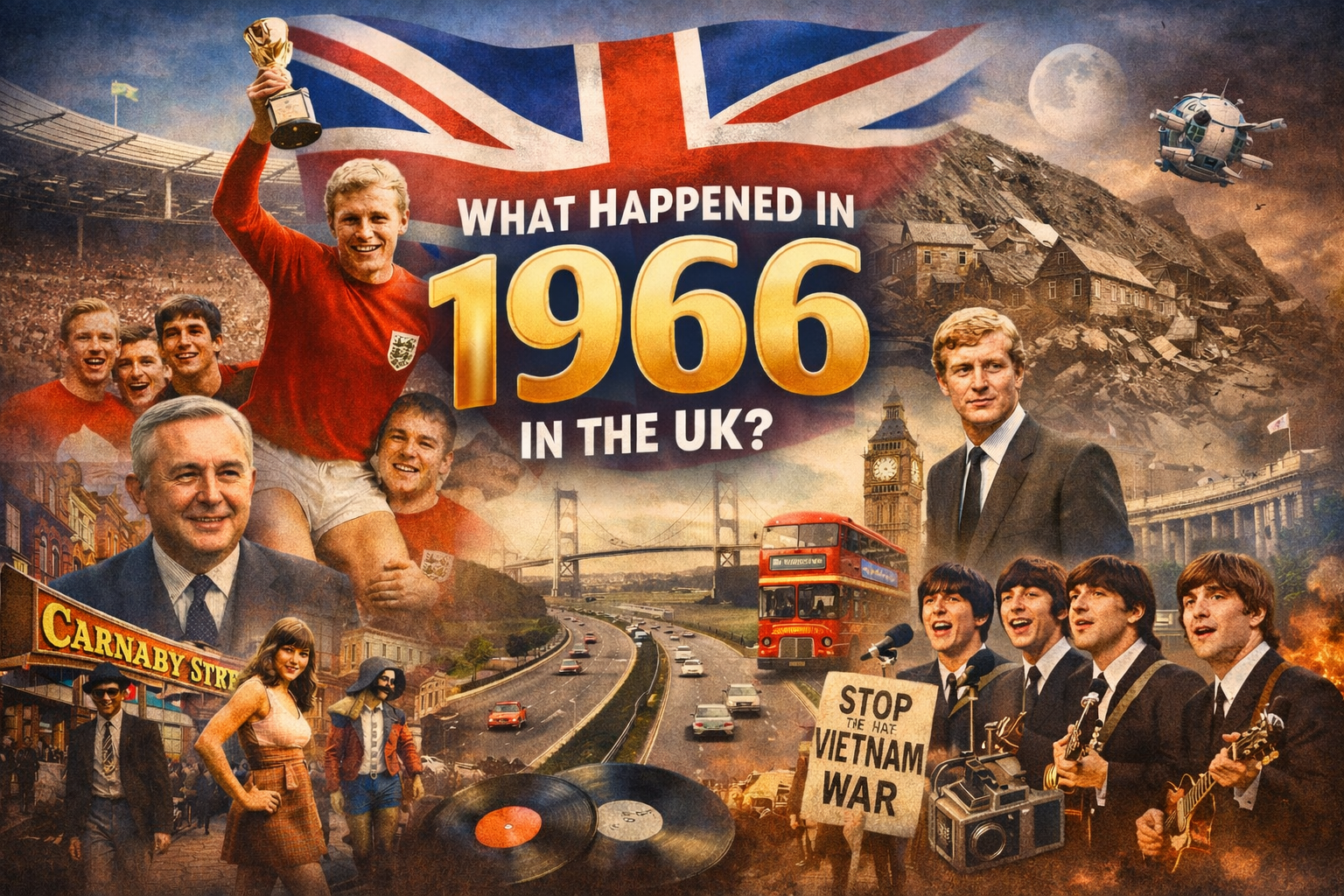
1966 was a year that Britain will never forget. From the roar of Wembley as England lifted the World Cup, to the shock and sorrow of the Aberfan disaster, it was a year of unforgettable highs and heart breaking lows. On the 60th anniversary, this page looks back at what happened in 1966 in the UK, revisiting the moments, people and changes that shaped a remarkable year in British history.
Table of Contents
What Happened in 1966 in the UK?
The year 1966 stands as one of the most memorable and emotionally charged years in modern British history. Sixty years on, it is remembered for moments of extraordinary national pride, profound tragedy, and rapid social and cultural change. From the ballot box to the football pitch, from television screens to new motorways reshaping the landscape, 1966 left a lasting imprint on the United Kingdom.
Major Events of 1966 in the UK
Politics, sport, and national life collided in dramatic fashion during 1966. On 31st March, the United Kingdom went to the polls in a general election that delivered a decisive outcome. The Labour Party, led by Harold Wilson, secured a landslide victory with 364 seats and 48.0 per cent of the vote, strengthening the government’s mandate at a time of economic and social reform.
Just four months later, the country experienced one of its greatest moments of collective celebration. On 30th July, the England football team lifted the FIFA World Cup at Wembley, defeating West Germany 4–2 in the final. The victory transformed the national mood and became one of the defining cultural touchstones of the post-war era.
That same year also brought devastating loss. On 21st October, the Aberfan disaster in South Wales shocked the nation when a colliery spoil tip collapsed onto the village, killing 144 people, including 116 children. The tragedy prompted widespread grief and remains one of the most painful events in modern UK history.
Alongside these defining moments, 1966 was a year of physical transformation. Throughout the year, the UK motorway network continued to expand, with major developments to the M1, M4 – including the opening of the Severn Bridge – the M32 and the M74, signalling a new era of mobility and modern infrastructure. The Queen officially opens the Post Office Tower (later renamed to BT Tower) in London to aid the telecommunications infrastructure.
Cultural and intellectual life also advanced, with the founding of the London School of Contemporary Dance and international recognition for British scholarship when mathematician Sir Michael Atiyah was awarded the Fields Medal.
Global Events That Shaped the UK in 1966
Events beyond Britain’s borders also resonated strongly at home. England’s World Cup victory, achieved on home soil at Wembley, echoed far beyond sport, reinforcing Britain’s global cultural profile.
Changes within the Commonwealth were marked when Basutoland became independent as Lesotho on 4th October, reflecting the continuing reshaping of Britain’s international relationships. Meanwhile, the Cold War remained a powerful backdrop to daily life. In space, the Soviet Union’s Luna 10 became the first spacecraft to orbit the Moon, intensifying scientific rivalry and public fascination with the space race.
Political tensions closer to home were visible on the streets of London, where protests against the Vietnam War took place during 1966, including clashes outside the United States embassy. These demonstrations highlighted the growing confidence of protest movements and the increasingly vocal role of public opinion in international affairs.
UK Music in 1966
British music continued to push boundaries in 1966, led by artists who were redefining what popular music could be. In August, The Beatles released Revolver, an album that marked a decisive shift towards studio experimentation and is widely regarded as a landmark in modern music.
The year was also marked by loss within the musical community. Composer Benjamin Burrows died on 28th January at the age of 74. October saw the tragic death of Johnny Kidd in a car accident. Their passing formed part of a year that mixed creative innovation with moments of reflection.
Singles in 1966
The year started with The Beetles at number one with their double A side Day Tripper /We Can work it Out and the year ended with the best seller for the year; Green, Green Grass of Home by Tom Jones . Distant Drums by Jim Reeves spent the longest time at number one in this year with 5 weeks.
Films That Defined 1966 in the UK
Cinema audiences in 1966 were drawn to films that reflected changing attitudes and modern British identity. Alfie, starring Michael Caine, and Georgy Girl were both popular releases in UK cinemas, capturing the spirit and contradictions of contemporary London life. The biopic, Born Free was also released receiving a Royal Film Performance in this year. The Carry on… franchise continued in this year with Carry On Screaming starring Jim Dale and Harry H Corbett.
British filmmaking also received international recognition during the 1966–67 awards season. A Man for All Seasons won the Academy Award for Best Picture, while the BAFTA for Best British Film was awarded to The Spy Who Came In from the Cold, reinforcing the global reputation of British cinema during the decade.
Science and Technology in Britain, 1966
Progress and modernisation were central themes of 1966. The continued expansion of the motorway network reshaped travel and commerce, while the founding of the London School of Contemporary Dance reflected innovation within education and the arts.
In healthcare, the 1966 GP Contract was agreed, a significant development that influenced the organisation and delivery of general medical practice across the country.
Sport in the UK During 1966
No sporting year is more closely associated with national memory than 1966. England’s 4–2 victory over West Germany in the World Cup final on 30 July remains unmatched in English football history.
The success of the football team was further recognised in December, when England captain Bobby Moore was named BBC Sports Personality of the Year. Earlier in May, football fans were treated to a rare spectacle when Brazilian legend Pelé played an exhibition match in the UK, appearing for Santos against West Ham United, adding further excitement to an already remarkable sporting year.
Australian Jack Brabham won this year’s British Grand Prix, notable by the move to uprated 3 Litre engines.
Television Highlights of 1966
Television in 1966 continued to evolve in both form and ambition. On 3rd March, the BBC announced plans to begin colour broadcasting in the next year, pointing towards a new visual era for viewers.
BBC2 expanded its factual output with the debut of The Money Programme on 5th April, while BBC1 introduced socially charged comedy with the launch of Till Death Us Do Part on 6th June. Later in the year, on 16th November, Cathy Come Home aired on BBC1. Its powerful portrayal of homelessness would go on to be regarded as one of the most influential British television plays ever broadcast.
ITV begins showing Batman, the American live-action series, starring Adam West and Burt Ward. They also show the last episode of Thunderbirds using a form of marionette puppetry called “Supermarionation” for the fist time, although due to it’s popularity it is often repeated.
The World Cup final attracted an all time record number of UK viewers at over 32 Million.
Interesting Facts and Figures from 1966
Throughout 1966, Elizabeth II remained monarch, with Harold Wilson serving as Prime Minister following Labour’s election victory.
Births, Deaths, and Marriages in 1966
Births
The year saw the birth of several figures who would later become familiar names in British culture, including Tamsin Greig, Johnny Vaughan, Toby Jones, Ruth Jones and Ben Miles.
- 6th February – Rick Astley, British singer, songwriter, radio DJ and podcaster.
- 20th February – Cindy Crawford, American model, actress and television personality.
- 24th February – Ben Miller, English comedian, actor and director
- 1st March – Paul Hollywood, chef and television presenter
- 6th March – Alan Davies, comedy performer
- 19th March – Nigel Clough, English footballer and football manager
- 31st March – Roger Black, English 400 m runner
- 1st April – Chris Evans, broadcast music presenter
- 2nd April – Teddy Sheringham, English footballer
- 11th April – Lisa Stansfield, British soul singer
- 15th April – Cressida Cowell, Children’s author, known for novel How to Train Your Dragon
- 15th April – Samantha Fox, British model and singer
- 21st April – Chris Whitty, epidemiologist, Chief Medical Officer for England
- 29th April – Phil Tufnell, British cricketer
- 30th April – Pooky Quesnel, English actress
- 10th May – Jonathan Edwards, British athlete, an Olympic, double World, European, European indoor and Commonwealth champion
- 16th May – Janet Jackson, American singer, songwriter, actress, and dancer.
- 26th May – Helena Bonham Carter, English actress
- 27th May – Heston Blumenthal, chef and food writer
- 28th June – John Cusack, American actor.
- 30th June – Mike Tyson, former professional Boxer.
- 11th July – Melanie Appleby, singer - Died: 1990
- 12th July – Tamsin Greig, actress
- 16th July – Johnny Vaughan, journalist and critic
- 10th August – Charlie Dimmock, English TV gardening expert
- 9th September – Adam Sandler, American actor, comedian, filmmaker, and singer-songwriter.
- 9th October – David Cameron, Previous British Conservative Party leader, Prime Minister of the United Kingdom and MP for Witney.
- 10th October – Tony Adams, English footballer
- 11th October – Luke Perry, actor. - Died: 2019
- 8th November – Gordon Ramsay, Scottish-born chef
- 12th November – David Schwimmer, American actor, director and producer.
- 30th November – John Bishop, English comedian, presenter and actor
- 8th December – Sinead O'Connor, Irish singer-songwriter - Died: 2023
- 16th December – Dennis Wise, English footballer and football manager
- 21st December – Kiefer Sutherland, English-born Canadian actor
Deaths
Notable deaths included novelist Evelyn Waugh on 10th April, crime writer Margery Allingham on 30th June, and singer Alma Cogan on 26 October.
- 8th March – William Astor, 3rd Viscount Astor, politician (born 1907)
- 11th March – Clara Rackham, women’s suffrage activist (born 1875)
- 2nd April – C. S. Forester, novelist (born 1899)
- 9th April – Barry Butler, footballer, car accident (born 1934)
- 10th April – Evelyn Waugh, novelist (born 1903)
- 14th May – Megan Lloyd George, Welsh politician (born 1902)
- 1st July – Pauline Boty, pop art painter (born 1938)
- 13th July – Princess Beatrice, granddaughter of Queen Victoria, married into the Spanish royal family (born 1884)
- 25th September – Billy Smart Sr., circus owner (born 1894)
- 7th October – Johnny Kidd, rock singer/songwriter, car accident (born 1935)
- 10th October – Charlotte Cooper, tennis player (born 1870)
- 26th October – Alma Cogan, pop singer (born 1932)
Marriages in the Year 1966
Some interesting marriages happened in 1966; Sophia Loren remarries Carlo Ponti after the couple had their marriage annulled to escape bigamy charges in Italy (divorce was illegal there) They both became French citizens in 1965 which enabled Ponti to divorce his wife to legally marry Loren. They remained married until Ponti’s death in 2007.
- 21st January – George Harrison marries Pattie Boyd at Epsom Registry office
- 10th February – Bob Marley marries Rita Anderson
- 17th March – Keith Moon marries Kim Kerrigan - Div. 1975
- 9th April – Sophia Loren remarries Carlo Ponti
- 16th April – (Sir) Michael Palin marries Helen Gibbins, they remain married until her death in 2023.
- 30th May – Dolly Parton marries Carl Dean in Ringgold, Georgia. Carl passed away in March 2025, they were still married.
- 14th July – Brigitte Bardot marries Gunter Sachs. This is her third of four marriages, it was short and the couple split up in 1968 divorcing the year later. - Div. 1969
- 19th July – Frank Sinatra & Mia Farrow marry and divorce 2 years later. - Div. 1968
- 10th September – John Lithgow marries Jean Taynton. - Div. 1980
Anniversaries in 1966
- Centenary of the London Fire Brigade
- 50th Anniversary of Daylight Saving being introduced.
- The Yorkshire Post celebrates 100 years as a daily newspaper.
- Writers Beatrix Potter and H.G. Wells are celebrated on the Centenary of their Birth.
- J R R Tolkien and Edith Mary Tolkien (nee Bratt) celebrate their Golden Wedding.
- 50th Anniversary of English Composer Gustav Holst completing ‘The Planets’
Everyday life was shaped by economic realities, with the average weekly household income in early 1966 recorded at approximately £24 2s 11d.
Symbol of 1966: Chinese Zodiac
1966 in the Chinese lunar calendar was the Year of the Horse (specifically the Fire Horse). The old superstition (especially in Japan & China)
Historically, the Fire Horse—particularly girls born in Fire Horse years—were believed to be:
“Too strong, too independent, and destined to bring misfortune to their husbands.”
This sounds archaic now, but it had real social impact:
- Japan’s birth rate fell sharply in 1966 because families avoided having children that year.
- Women born in 1966 sometimes faced stigma in older generations.
Modern astrology treats this as folklore, but it shows how powerful the reputation of this sign was.
Fashion and Youth Culture in 1966 Britain
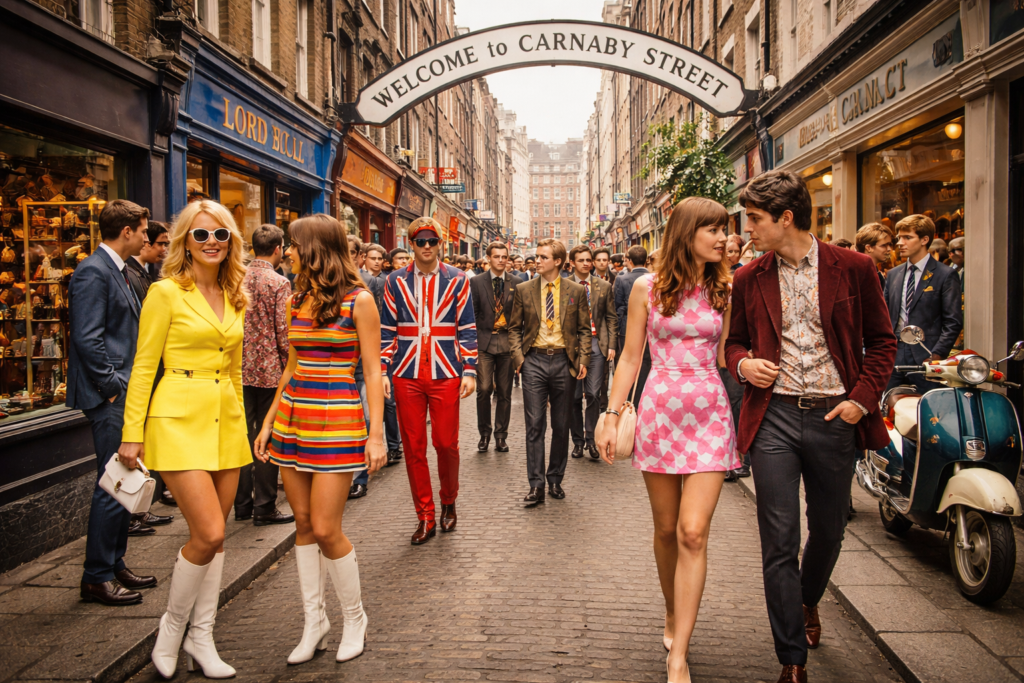
Fashion in 1966 reflected the confidence and creativity of the Swinging Sixties. Mod styles remained highly influential, with bold patterns, strong colour palettes and mini-skirts defining the look of the decade.
Youth culture continued to set the pace, particularly in London. Carnaby Street and the King’s Road were firmly established as trendsetting centres, shaping how Britain dressed and how it was seen around the world.
The Cost of Living in the UK in 1966
Economic pressures were never far from public attention. In October 1966, unemployment stood at 437,229, representing a sharp month-on-month rise of around 100,000. Weekly average income remained at approximately £24 2s 11d, while the Retail Price Index for the year was recorded at around 15.6.
| Item | Price in 1966 | Price in 2025 | Notes |
|---|---|---|---|
| Loaf of Bread (800g) | £0.09 | £1.45 | Basic staple; price growth reflects wheat costs, energy, and retail margins. |
| Pint of Milk | £0.04 | £0.85 | Historically price-controlled; now influenced by global dairy markets. |
| Dozen Eggs | £0.07 | £2.80 | Feed costs, welfare standards, and supply shocks drive modern pricing. |
| Litre of Petrol | £0.05 | £1.55 | Includes fuel duty and VAT; oil prices and taxation dominate change. |
| Pint of Bitter (pub) | £0.15 | £5.20 | Strong indicator of social inflation and hospitality overheads. |
| Average House Price | £3,500 | £290,000 | Illustrates long-term housing supply constraints and demand growth. |
| Average Annual Salary | £850 | £35,000 | Earnings growth has not kept pace with housing and asset inflation. |
Gift Ideas for 1966
-
 Congratulation on your Diamond Anniversary Greeting Card£2.49
 -
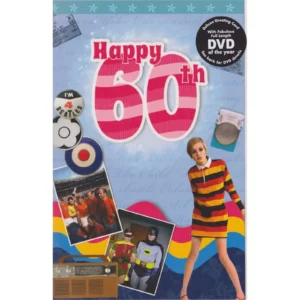
1966 Your Special Year DVD Greeting Card — 60th Birthday Card£3.95
-
Product on saleDiamond 60th Anniversary Invitation Cards (Pack of 10) by Jean BarringtonOriginal price was: £3.95.£2.49Current price is: £2.49.
-
The DVD Milestones -Happy 60th£10.95
-
Diamond Anniversary 5×7 Photo Frame£17.99
-
A Perfect Love Diamond Anniversary Pillar Candle, free Personalisation£14.95
-
Wishing you a Happy Diamond Anniversary Greeting Card£3.95
-
Product on saleWishing you a Happy Diamond Anniversary Greeting CardOriginal price was: £4.99.£2.99Current price is: £2.99.
Looking Back at 1966
On it’s 60th anniversary, 1966 remains a year of contrasts: triumph and tragedy, optimism and uncertainty. It was a year when Britain celebrated on a global stage, confronted deep sorrow at home, and continued its transformation into a modern, outward-looking society. For many, the events of 1966 are not just history, but shared memories that still resonate today.
As we reflect on these moments years later, it’s clear that the events of 1966 still shape our lives today. Whether through music, fashion, or policy changes, this was a year that truly made history.
