
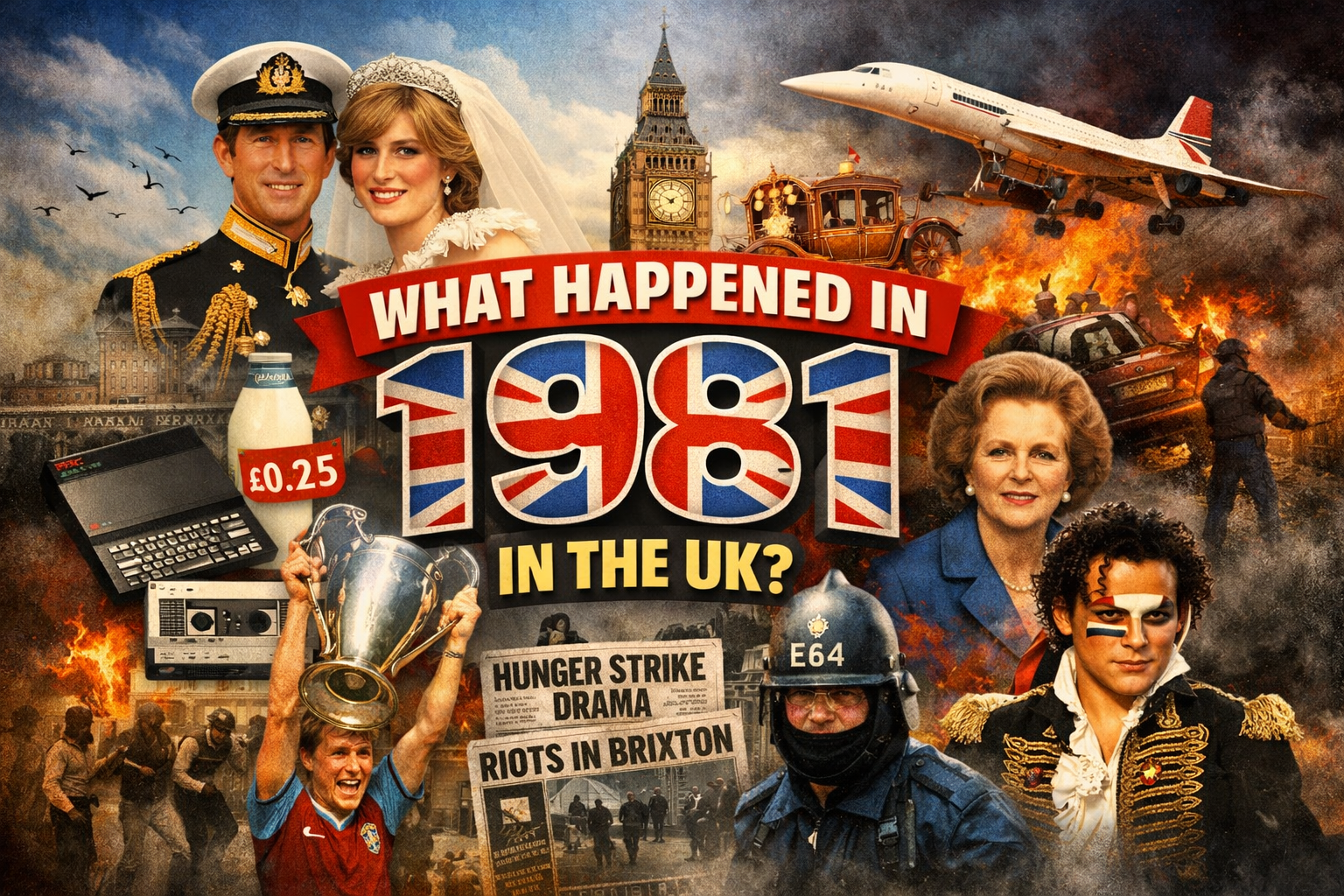
In 2026, we mark the 45th anniversary of 1981, a year that left a lasting impact on the United Kingdom. Interested in what happened in 1981 in the UK? From cultural milestones to ground breaking technological shifts, let’s journey back in time to explore the defining moments that shaped this remarkable year.
If you were born in 1981 you would be celebrating your 45th Birthday this year, likewise if you married in 1981 you will be celebrating your 45th Wedding Anniversary this year.
1981 UK history is often remembered as a year of sharp contrasts: deep recession and unrest alongside moments of national pride, cultural breakthroughs, and early-80s innovations that still echo today. With the 45th anniversary of 1981 approaching in 2026, it’s a good moment to look back at the events, trends, and talking points that defined the year.
Table of Contents
Turning points and lasting legacies in 1981 UK history
Queen Elizabeth II was monarch throughout 1981, while Conservative Prime Minister Margaret Thatcher led the government in her second year in office. Her administration pursued strict fiscal policies during a period of recession and social unrest.
The economic picture was bruising. Inflation averaged around 11.9% in 1981 (down from nearly 18% in 1980). Unemployment surged above 2.5 million (over 10% of the workforce), a level not seen in decades. Industrial output stagnated, and austerity measures bit hard.
Socially, the country felt under pressure. Severe inner-city riots in places including Brixton, Toxteth and Moss Side were fuelled by racial tensions, joblessness, and distrust of police. In Northern Ireland, IRA prisoner hunger strikes led by Bobby Sands drew global attention and intensified the Troubles. Ten prisoners died before the protest ended on 3 October.
By many accounts, Britain faced “an extremely challenging year” under Mrs Thatcher’s government, with hardship and unrest testing national resilience. Yet 1981 also brought moments of unity and uplift, including a royal wedding watched worldwide and iconic sporting victories that cut through the gloom.
Major events of the year: what happened in 1981 UK-wide?
The year’s timeline moved quickly, and often dramatically.
Early January delivered a major policing milestone: on 5 January, police charged Peter Sutcliffe with the “Yorkshire Ripper” murders of 13 women, ending a years-long case. (In May, Sutcliffe later confessed to the killings.)
In February, media and monarchy both made headlines. On 13 February, Rupert Murdoch acquired The Times and The Sunday Times, expanding his newspaper empire and sparking controversy over media concentration. On 24 February, Buckingham Palace announced the engagement of Prince Charles to Lady Diana Spencer, setting up a royal wedding that would dominate the year’s mood and media.
Northern Ireland’s hunger strike became a central thread of 1981. On 1 March, prisoner Bobby Sands began a hunger strike in the Maze Prison (he died on 5 May). On 10 April, Sands won a by-election to become MP for Fermanagh and South Tyrone, a symbolic victory for the republican movement, though he died less than a month later without taking his seat. The hunger strike was officially called off on 3 October after seven months; in total, 10 prisoners died.
Politics shifted in Great Britain too. On 26 March, the Social Democratic Party (SDP) was founded by the “Gang of Four”: Roy Jenkins, Shirley Williams, David Owen and Bill Rodgers. The breakaway signalled a major attempt to “break the mould” of two-party politics.
In April, unrest exploded in London. From 10–12 April, intense rioting erupted in Brixton. Over 300 people were injured (mostly police) and buildings were torched in clashes sparked by racial tensions and economic distress. The government appointed Lord Scarman to investigate the causes.
Summer brought more trouble. Starting 3 July in Toxteth (Liverpool), riots flared across multiple cities, with unrest reaching Moss Side (Manchester) by 8 July, underlining wider urban frustration.
But 1981 wasn’t only conflict. Football delivered an enduring Wembley memory: on 14 May, Tottenham Hotspur won the 1981 FA Cup, defeating Manchester City 3–2 in a replay, with Ricky Villa scoring a famous solo goal.
Then came the spectacle that briefly united the living rooms of the country. On 29 July 1981, Prince Charles married Lady Diana Spencer at St Paul’s Cathedral in London. An estimated 600,000 people lined the streets, and hundreds of millions watched worldwide as Diana became the Princess of Wales.
The autumn also saw activism take root. A group of Welsh women established the Greenham Common Women’s Peace Camp outside RAF Greenham Common on 5 September, protesting planned US nuclear missiles in Britain. It would become a long-running fixture of the peace movement through the 1980s.
Britain’s global footprint continued to change as decolonisation progressed. Belize attained independence on 21 September, and Antigua and Barbuda became independent on 1 November. Both joined the Commonwealth with the Queen as head of state.
Late in the year, the weather made history. On 23–25 November, a freak event brought 105 tornadoes recorded in a single night: an unprecedented swarm that caused damage across cities and towns. No fatalities were reported, but it remains a UK record for tornado outbreaks.
And in labour politics, a key figure rose. On 8 December, Arthur Scargill was elected President of the National Union of Mineworkers (NUM), signalling a more confrontational stance that would loom large later in the decade.
Global events that happened in 1981 and shaped the mood
Even from a UK perspective, 1981 was a year when international headlines felt close to home.
On 1 January, Greece joined the European Economic Community as its 10th member state, reinforcing the direction of European integration for EEC members including the UK.
On 20 January, 52 American hostages were released from Iran after 444 days, on the same day Ronald Reagan was inaugurated as US President. Britain welcomed the peaceful end of the crisis, which had dominated global attention.
Two assassination attempts stunned the world: on 30 March, President Reagan survived being shot in Washington, D.C., and on 13 May, Pope John Paul II was shot and wounded in St Peter’s Square, Rome.
In the Middle East, a political earthquake followed on 6 October, when Egyptian President Anwar Sadat was assassinated during a Cairo military parade. Hosni Mubarak assumed the presidency on 14 October. Sadat’s death reverberated internationally, with Britain mourning the loss of a key architect of Middle East peace.
Cold War tensions remained high. In the USSR, Leonid Brezhnev stayed in power as his health failed, while in Poland on 13 December, General Wojciech Jaruzelski imposed martial law to crush the Solidarity movement. Even so, by late 1981 there were signals of willingness to resume arms control talks.
Technological milestones also captured attention. The IBM Personal Computer launched in the United States on 12 August, while NASA’s Space Shuttle programme achieved its first flight with Columbia in April. The UK had no direct role, but British observers watched a changing world accelerate.
Economically, a global recession hit hard. Internationally, 1981 is remembered as a year of austerity and adjustment after the oil shocks of the 1970s, with inflation and joblessness a common theme across the West.
UK music of 1981: chart drama, synth-pop and social commentary
If you’re asking “what happened in 1981 UK” in cultural terms, the sound of the year is a big part of the answer.
The UK saw 20 different songs reach No.1 on the Singles Chart in 1981. The year opened with St Winifred’s School Choir’s novelty tune “There’s No One Quite Like Grandma”, and closed with “Don’t You Want Me” by The Human League on top.
That Human League hit was the best-selling single of the year. “Don’t You Want Me” spent 5 weeks at No.1 and sold approximately 1.15 million copies. For decades, industry data mistakenly credited Soft Cell’s “Tainted Love” as the year’s top seller until updated figures put The Human League at No.1.
New Wave and New Romantic acts dominated. Adam & The Ants had a breakout year with two No.1s—“Stand & Deliver” and “Prince Charming”—which together spent 9 weeks at the top. They were also the UK’s best-selling singles act of 1981, placing four songs in the year-end Top 50.
1981 also delivered a classic Eurovision moment: on 4 April, Bucks Fizz won the Eurovision Song Contest for the UK with “Making Your Mind Up”, which shot to No.1 in Britain and became one of the year’s best-selling singles.
And the year carried a strong emotional undertow. Early 1981 saw posthumous chart success for John Lennon: “Imagine” (re-released) and “Woman” hit No.1 in January–February, while Roxy Music’s “Jealous Guy” reached No.1 in March as a Lennon tribute cover.
Synth-pop rose hard and fast: alongside The Human League were acts like Soft Cell, Depeche Mode (with a debut album in October), and Ultravox. Meanwhile, The Specials’ “Ghost Town” hit No.1 in July, capturing the mood of urban decay during the riots with a haunting commentary that made the charts feel like a front page.
Singles of the year: the UK’s biggest sellers in 1981
According to Official Charts Company data, the Top 5 best-selling UK singles of 1981 were:
| Rank | Song | Artist(s) | Notes |
|---|---|---|---|
| 1 | “Don’t You Want Me” | The Human League | 5 weeks at #1; 1.15m sold |
| 2 | “Tainted Love” | Soft Cell | 2 weeks at #1; ~1.05m sold |
| 3 | “Stand & Deliver” | Adam & The Ants | 5 weeks at #1 |
| 4 | “Prince Charming” | Adam & The Ants | 4 weeks at #1 |
| 5 | “This Ole House” | Shakin’ Stevens | 3 weeks at #1 |
All of the above singles reached No.1 on the UK chart during 1981.
Music albums of the year 1981 in the UK
On the albums side, 1981 captured both reinvention and nostalgia.
The year’s best-selling album in the UK was Adam & The Ants’ Kings of the Wild Frontier (released late 1980). Close behind was Queen’s Greatest Hits (released October 1981), which debuted at No.1 and has since become the UK’s best-selling album of all time with over 7 million copies sold.
Phil Collins launched his solo career with Face Value (February 1981), featuring “In the Air Tonight”. The album spent 5 weeks at No.1 and was among the top sellers of the year.
In October, The Human League released Dare, which hit No.1, propelled by “Don’t You Want Me” and helping define British electronic pop’s global reach by year’s end.
Other chart-toppers included The Police’s Ghost in the Machine (October 1981) and Shakin’ Stevens’ Shaky, reinforcing how 1981’s charts could hold both edgy new pop and mainstream favourites at once.
Top UK movies of 1981
Cinema in 1981 offered escapism, prestige, and a few films that stuck around for decades.
Raiders of the Lost Ark was a worldwide blockbuster and a big hit in UK cinemas, reinvigorating the action-adventure genre.
The James Bond franchise returned with For Your Eyes Only (premiered June 1981), starring Roger Moore. It was among the UK’s top-grossing movies of the year, earning over £6 million.
British cinema had a major triumph with Chariots of Fire (released March 1981), which later won 4 Academy Awards, including Best Picture at the 1982 Oscars, and left an iconic theme in popular culture.
Big-screen spectacle also came from Superman II (UK release in 1981), partly filmed at Pinewood Studios, which topped the UK box office in 1981 with about £9.5 million gross.
And 1981 delivered notable homegrown films too: The French Lieutenant’s Woman (September 1981), Gregory’s Girl (April 1981), and Time Bandits (July 1981), creating a year that felt unusually rich in variety.
What Happened in 1981 in the UK Science and technology
Some of 1981’s biggest legacies were quietly built in bedrooms, schools, and laboratories.
On 5 March, Sinclair Research launched the affordable ZX81 home computer in the UK. Priced at £69.95 in kit form, it sold over 1.5 million units worldwide, helping make computing accessible to British households and hobbyists.
Later in the year, on 1 December, the BBC Microcomputer was released as part of the BBC’s Computer Literacy Project. Designed by Acorn Computers, it aimed to put a microcomputer in every UK school and became hugely influential, with over 1.5 million eventually sold.
In Northern Ireland, manufacturing also made headlines. On 21 January, the first DeLorean DMC-12 rolled off the production line in Dunmurry, featuring gull-wing doors and a stainless-steel body, backed by UK government incentives.
In telecoms, the British Telecommunications Act 1981 took effect on 1 October, formally separating British Telecom (BT) from the Post Office postal service and setting the stage for later changes to UK telephone services.
The year also touched public health history: in October 1981, the first AIDS-related death in the UK was retrospectively identified (a patient at Brompton Hospital), prompting early discussion by year’s end.
Sports of 1981: iconic wins and unforgettable moments
Sport gave 1981 some of its most fondly recalled chapters.
Cricket fans still speak of “Botham’s Ashes”. In July, England won the Third Ashes Test at Headingley after following-on, powered by Ian Botham (149 runs) and Bob Willis with the ball. England went on to win the 1981 Ashes series 3–1.
In football, Aston Villa won the Football League First Division title for 1980/81—clinching the championship on 2 May 1981, their first in 71 years. In Europe, Liverpool won the 1981 European Cup on 27 May, defeating Real Madrid 1–0 in Paris, with Alan Kennedy scoring the winner. Liverpool also won the League Cup in 1981, completing a cup double.
Endurance sport found a new London institution. The first London Marathon took place on 29 March 1981: 7,055 runners started, 6,255 finished, and the race ended in a famous tie as Dick Beardsley and Inge Simonsen crossed the line together as joint winners in 2:11:48.
Snooker entered a new era on 20 April, when Steve Davis, aged 23, won his first World Snooker Championship at the Crucible, beginning a period of dominance that helped define the sport’s 1980s boom.
Wimbledon delivered both brilliance and theatre. In June, John McEnroe shouted “You cannot be serious!” at an umpire on 22 June after a disputed call, then went on to win the men’s singles title in July, ending Björn Borg’s five-year reign. Chris Evert won the women’s title.
And Britain’s middle-distance rivalry kept the mile record in British hands. On 26 August, Sebastian Coe broke the record on 28 August with 3:47.33. Steve Ovett had set the record previously with 3:47:33
Horse racing added a national talking point: Shergar won the 1981 Epsom Derby on 3 June by a record 10 lengths, ridden by Walter Swinburn.
UK television of the year 1981
If you want to understand everyday 1981 UK life, you can’t ignore what people watched.
The royal wedding broadcast on 29 July was a television event on a rare scale: an estimated 750 million viewers worldwide watched the ceremony live. In the UK, BBC and ITV coverage made it the broadcasting highlight of the year.
1981 also introduced a future comedy institution. On 8 September, BBC1 aired the first episode of Only Fools and Horses, created by John Sullivan and starring David Jason as Del Boy Trotter.
Children’s TV gained a long-running favourite too. Postman Pat premiered on BBC1 on 16 September.
Meanwhile, ITV’s lavish adaptation of Brideshead Revisited aired October–December 1981, becoming a major critical and audience success and setting a new standard for literary adaptations.
Doctor Who marked a turning point: Tom Baker’s seven-year run as the Doctor ended in March 1981, regenerating into Peter Davison.
Behind the scenes, 1981 was also a year of anticipation: while Channel 4 did not launch until 1982, the broadcasting world buzzed with preparations and commissions, signalling bigger shifts to come.
Interesting facts and figures about What Happened in 1981 in the UK
The 1981 UK Census, conducted on 5 April 1981, recorded a total resident population of approximately 56.3 million across England, Scotland, Wales and Northern Ireland.
Politically, the UK was governed by a Conservative majority under Thatcher. Her anti-inflation measures were controversial, and her approval ratings plunged below 30% during 1981. Labour, led by Michael Foot, faced internal splits that fed into the SDP breakaway.
Economically, the recession was stark: GDP shrank by around 1%, and by year’s end over 2.9 million Britons were jobless, the highest since the 1930s. Interest rates remained high, with the Bank of England base rate around 14% for much of 1981. Chancellor Geoffrey Howe’s March Budget cut public spending amid the downturn, prompting a Times letter signed by 364 economists protesting its severity.
Socially, urban unrest became a defining theme. The Scarman Report (November 1981) investigated the causes of riots, highlighting racial disadvantage, youth unemployment over 50% in some inner-city areas, and over-aggressive policing (including “sus” law stops). Measures were announced to improve inner-city conditions, including job schemes and community policing.
Northern Ireland remained intensely violent. Over 100 people were killed there during the year, and the IRA bombing at Chelsea Barracks in London on 10 October killed 2 and injured many soldiers and civilians. In November, Sinn Féin under Gerry Adams began a shift towards contesting elections in the wake of hunger strike politicisation.
Weather swung to extremes. January brought severe snowstorms in parts of the UK, while summer was relatively cool and wet. The “night of 100 tornadoes” arrived on 23 November, and December 1981 included Britain’s coldest December night of the 20th century: −25°C in Shropshire on 12 December.
Culturally, Britain was still a three-channel nation. Top ratings went to the Royal Wedding (over 28 million UK viewers). In literature, Salman Rushdie published Midnight’s Children in 1981, which won the Booker Prize.
Best video games of 1981: arcades, early hits and UK studios on the horizon
Video gaming was booming in the early 1980s, largely through arcades and 8-bit consoles. In 1981, popular games in UK arcades included Space Invaders, Pac-Man, and newer hits like Galaga and Defender.
The launch of the Sinclair ZX81 (and the following year’s ZX Spectrum) helped set the stage for home-grown British games. 1981 also saw the founding of UK game developers including Imagine Software and Ultimate Play the Game.
Symbol of 1981: Chinese Zodiac
1981 in the Chinese lunar calendar was the Year of the Rooster (specifically the Metal Rooster). Chinese New Year 1981 started on 5 February 1981, which is why some sources describe 1981 as the Year of the Rooster beginning from that date.
Births, deaths and marriages in 1981
Births in 1981
- 30 January – Peter Crouch ( Footballer)
- 31 January – Justin Timberlake (Singer)
- 9 February – Tom Hiddleston (Actor)
- 15 May – Zara Phillips (Daughter of Princess Anne)
- 25 June – Sheridan Smith (Actress)
- 4 September – Beyoncé ( Singer)
- 26 September – Serena Williams ( Tennis Player)
Overall, around 721,000 babies were born in the UK in 1981 (ONS data), reflecting a small uptick from the late 1970s low.
Deaths in 1981
- 16 January – Bernard Lee aged 73 ( Actor best known for playing M in James Bond)
- 9 February – Bill Haley aged 55 ( Rock Singer and Guitarist)
- 11 May – Bob Marley aged 36 ( Reggae Musician)
- 24 May – Jack Warner aged 85 ( Actor best known for playing PC George Dixon in Dixon of Dock Green)
- 11 September – Harold Bennett aged 82 ( Actor)
- 29 September – Bill Shankly aged 68 ( Footballer)
Marriages in 1981
The most famous marriage of the year was Prince Charles and Lady Diana Spencer, married 29 July 1981 at St Paul’s Cathedral, London.
Other marriages listed include
- 24 January – Davy Jones (Singer) married Anita Pollinger (Singer) – Divorced 1996
- 25 January – Bill Murray (Actor) married Margaret Kelly – Divorced 1996
- 27 April – Ringo Starr ( Singer/Drummer in the Beatles) married Barbara Bach (Actress)
- 14 June – Danielle Steel ( Author) married John Traina – Divorced 1996
- 5 October – Michelle Pfeiffer (Actress) married Peter Horton (Actor) – Divorced 1988
- 23 December – Chris Hadfield (Astronaut) married Helene Walter
Approximately 346,000 marriages took place in the UK in 1981, continuing the slight decline in marriage rates observed since the 1970s.
Anniversaries marked in 1981
1981 coincided with several historical milestones, even if few were headline-grabbing nationwide.
It marked the 25th anniversary of Suez (1956), the 50th anniversary of the Statute of Westminster (1931), and the 50th anniversary of Abbey Road Studios (opened 1931), commemorated by EMI with special recordings. It was also noted that the Queen and Prince Philip celebrated their 34th wedding anniversary, looking ahead to their 35th in 1982.
UK fashion of the year 1981
Fashion in 1981 is hard to separate from celebrity and music culture.
The royal wedding made a global statement. Lady Diana Spencer’s gown—ivory silk taffeta with huge puffed sleeves and a 25-foot train—became one of the most famous dresses in the world. Designed by David & Elizabeth Emanuel, it helped drive bridal trends towards “princess” sleeves, full skirts and romantic lace, with copies reportedly appearing almost immediately.
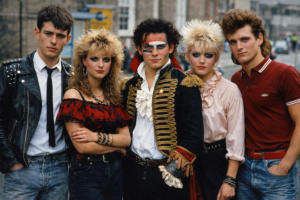
At street level, the New Romantic movement was at its peak around 1981. In London clubs like the Blitz, trendsetters including Boy George and Steve Strange wore flamboyant, androgynous looks: frilled shirts, velvet coats, theatrical makeup and bold hairstyles. The style filtered into the mainstream through bands such as Adam and the Ants, Spandau Ballet and Duran Duran.
Everyday fashion leaned casual: designer jeans and logo sports shirts were popular, alongside band-logo tees and skinny ties influenced by new wave. Women’s workwear showed early signs of “power dressing”, with tailored suits and padded shoulders beginning to appear.
Meanwhile, punk evolved into post-punk and goth looks—more black clothing and eyeliner, contrasting with the colour and drama of New Romantics. Vivienne Westwood’s “Pirate” collection arrived in 1981, embracing romantic themes that suited the era’s club culture.
UK cost of living in 1981: prices that now feel unreal
Even with inflation still high by modern standards, day-to-day prices in 1981 can look startling from today’s viewpoint. Here’s a snapshot of typical prices listed for 1981:
| Item | Average 1981 Price |
|---|---|
| Average house price | ~£24,000 (freehold) |
| Average annual salary | ~£6,000 (full-time gross) |
| Gallon of petrol (4.5 L) | £1.60 (≈35p per litre) |
| Pint of milk | 18½p |
| Large loaf of bread (800g) | 35½p |
| Pint of beer (pub) | 51p |
| 20 cigarettes (pack) | 78p |
| Bottle of whisky (750ml) | £6.09 |
| Daily newspaper | 12p–14p (tabloids ~12p; Times 20p) |
| First-class stamp | 15p |
For context, £1 in 1981 is described here as equivalent to roughly £3.50–£4.00 in today’s money in terms of retail prices, or nearly £5 in terms of average earnings, which helps explain why the year still felt financially punishing for many households.
Other everyday costs noted for 1981 include a new Ford Cortina at around £4,200, a basic 20″ colour TV at around £240, and a cinema ticket at about £2. Mortgage interest rates were around 15%, and high interest rates and weak demand put pressure on households and businesses alike.
Pros and cons of 1981’s developments
Pros
For supporters of the government’s direction, 1981 marked the start of a shift: tough fiscal policies helped tame inflation, falling from 18% to around 12% during the year.
It was also a landmark year for British computing. The ZX81 and the BBC Micro helped democratise computing, boosting computer literacy and seeding future success in UK game development.
Culturally, creativity flourished despite hardship: music, literature and art captured the social mood, and 1981 produced major works such as Midnight’s Children.
Politically, the SDP–Liberal Alliance created a new centrist option, reshaping the political landscape and influencing longer-term change.
Cons
The cost was heavy. Mass unemployment and spending cuts hit communities hard, and riots exposed deep racial and economic inequalities.
Industrial decline accelerated, with closures adding to hardship and widening the north-south divide. One cited example was the closure of Peugeot’s Talbot plant in Linwood in May, costing 5,000 jobs in Scotland.
In Northern Ireland, the hunger strikes and ongoing IRA campaign entrenched division, with escalating violence and a hardening of attitudes.
Critics also argued that cutting inflation came at the price of a deeper recession. The Times letter signed by 364 economists captured how controversial the approach was at the time, especially as small businesses struggled under high interest rates and low demand.
Gift ideas for 1981: thoughtful nostalgia for a 45th anniversary
If you’re celebrating someone with a 1981 connection—born that year, married that year, or simply nostalgic—these ideas tap straight into the era’s feel.
- 1981 music and memorabilia: an “1981 hits” CD or vinyl, paired with a reproduction-era concert poster.
- Classic video games: a retro system loaded with arcade staples like Pac-Man, Galaga, Donkey Kong and Frogger to recreate the early-80s arcade buzz.
- Film night pack: a Blu-ray of Raiders of the Lost Ark or Chariots of Fire, with proper throwback snacks for a time-travel evening.
- Royal wedding keepsakes: commemorative items connected to the 1981 wedding—coins, stamps, or a fine bone china plate.
- Vintage tech: a working Sinclair ZX81 or an early portable cassette player such as a Walkman-style device.
- Sports memorabilia: an Ashes-themed newspaper front page print celebrating 1981’s cricket drama, or a replica kit linked to that year’s football triumphs.
- Time capsule hamper: a box of 1981-flavoured items—coins, sweets, a paperback from the era, and a magazine or comic from the year.
- Personalised “1981” print: a framed design listing fun facts—birthdate, the No.1 song that week, and a few cost-of-living details like a pint of milk at 18½p.
Recommended products
-

1981 The Story of Your Year 45th Anniversary Booklet CD and Music Download
£11.95 -
45th Anniversary Card with Original Hit Music of 1981. A Time to Remember, The Classic Years.
£7.95 -
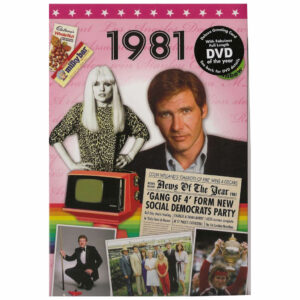
DVD Greeting Card, The Time of your Life -1981
£10.95 -
A Perfect Love Anniversary Pillar Candle, free personalisation
£14.95 -
Inspirational Anniversary Pillar Candle, free personalisation
£13.99 -
Me to You Couple Pillar Candle with Free Personalisation
£15.99 -
A Perfect Love 45th Anniversary Personalised Candle
£14.95 -
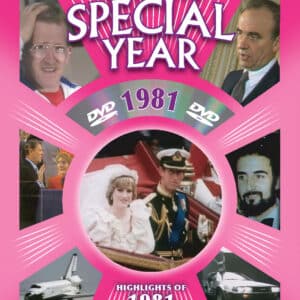
1981 Your Special Year DVD Greeting Card — 45th Birthday Card
£3.95


Reflecting on 1981: why the year still matters
Looking back, it’s easy to see why “what happened in 1981 UK” remains such a searched phrase. The year captured a country under strain—recession, unemployment, riots, and Northern Ireland’s tragedy—while also laying foundations for lasting change.
1981 brought political realignment through the SDP’s birth, a royal marriage that became a global cultural landmark, and early steps into the home-computing future via the ZX81 and BBC Micro. It also showed how British culture could act as a pressure valve: from chart-topping synth-pop and socially aware hits like “Ghost Town” to television moments that became national touchstones.
