
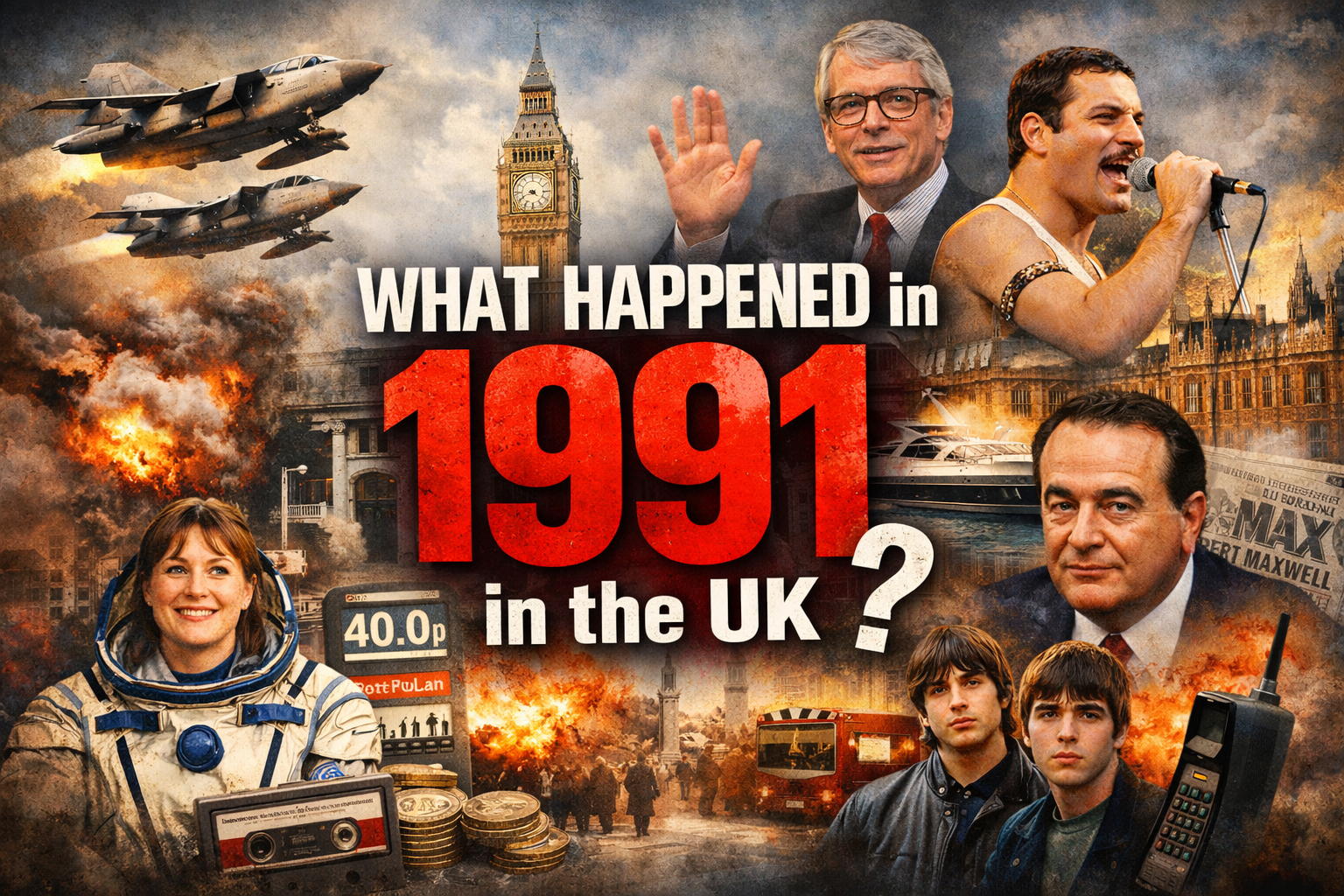
In 2026, we mark the 35th anniversary of 1991, a year that left a lasting impact on the United Kingdom. 1991 was a year when Britain stood at the intersection of conflict, change and cultural transformation. From the shock of war in the Gulf and an IRA attack at the heart of government, to moments of hope such as the birth of the World Wide Web and the UK’s first journey into space, the events of this year left a lasting imprint on the nation.
This page looks back at what happened in 1991 in the UK, exploring the headlines, the everyday realities, and the cultural moments that defined a turbulent yet pivotal year—one whose influence is still felt 35 years on.
If you were born in 1991 you will be celebrating your 35th Birthday this year, likewise if your marriage was 1991 you will be celebrating your 35th Wedding Anniversary this year.
35 years on, 1991 stands out as a year when Britain found itself at the crossroads of global conflict, technological change and cultural shift. From RAF jets flying into the Gulf War to the quiet birth of the World Wide Web, the UK experienced moments that still shape everyday life. It was also a year of upheaval and emotion: historic miscarriages of justice were corrected, beloved public figures were lost, and popular culture reflected a country balancing recessionary pressures with creative energy.
Table of Contents
Major Events That Shaped the UK in 1991
The year opened with Britain playing a direct role on the world stage. Between 17 January and 28 February, the UK joined the US-led coalition in the Gulf War, with RAF aircraft striking Iraq on the opening night. The conflict ended when Iraqi forces surrendered by the end of February, marking a defining moment in Britain’s post-Cold War military history.
At home, security concerns were sharply underlined on 7 February, when the IRA fired three mortar bombs at 10 Downing Street during a Cabinet meeting. The explosions shattered windows but caused no injuries, delivering a stark reminder of ongoing tensions.
Technological history was quietly made on 26 February, when British scientist Tim Berners-Lee introduced WorldWideWeb, the first-ever web browser. Later that year, the first website would go live, laying the foundations for how Britain and the world now communicate.
Justice and politics also dominated headlines. On 14 March, the Birmingham Six were freed after their 1975 convictions were quashed, ending 16 years of wrongful imprisonment. Days later, In March, Prime Minister John Major announced the abolition of the deeply unpopular poll tax, with a new Council Tax planned for introduction in 1993.
British achievement reached beyond Earth on 18 May, when Helen Sharman became the first Briton in space, spending eight days aboard the Mir space station. The year closed against a backdrop of seismic global change as the Soviet Union collapsed on 25–26 December, formally ending the Cold War.
Cost of Living in the UK in 1991
Economically, 1991 was a difficult year. Britain was in recession, with inflation hovering at around 5.9% and interest rates remaining high at approximately 13%. Everyday prices, viewed through a modern lens, reveal how living standards and costs have shifted over the past 35 years.
| Item | Price in 1991 | Approx. Price in 2024 | Notes |
|---|---|---|---|
| Loaf of Bread (800g) | £0.52 | £1.35 | Staple food item |
| Pint of Milk | £0.30 | £0.85 | Daily essential |
| Dozen Eggs | £0.96 | £2.30 | Household staple |
| Litre of Petrol | £0.40 | £1.65 | UK average unleaded |
| Pint of Beer (Bitter) | £1.10 | £4.25 | Typical pub price |
| Average House Price | £54,626 | £295,000 | UK-wide average |
| Average Annual Salary | ~£15,000 | £33,000 | Full-time earnings |
These figures capture the pressures facing households in 1991, alongside the long-term rise in wages and housing costs that followed.
1991 News Headlines in Britain
Several high-profile stories dominated the news agenda. On 8 August, British journalist John McCarthy was released after more than five years as a hostage in Beirut. Later in the year, on 18 November, Terry Waite was freed in Lebanon after 1,763 days in captivity.
A moment of historic diplomacy came on 16 May, when Queen Elizabeth II addressed a joint session of the US Congress, becoming the first British monarch to do so during a state visit to Washington.
Shock followed on 5 November with the death of media tycoon Robert Maxwell, found in the sea near the Canary Islands. The subsequent exposure of massive pension fund fraud sent tremors through British business and media.
The most emotional moment of the year came in late November. On 23 November, Freddie Mercury publicly announced that he had AIDS. Just 24 hours later, he died at his London home aged 45, prompting an outpouring of grief across the UK and beyond.
UK Popular Culture and Everyday Life in 1991
Popular culture in 1991 reflected both humour and change. In music, Oasis formed in Manchester, planting early seeds of the Britpop movement that would define the decade. Following Freddie Mercury’s death, Queen saw renewed popularity as listeners revisited their catalogue.
Television delivered new classics. BBC2 debuted the anarchic sitcom Bottom, starring Rik Mayall and Adrian Edmondson. Saturday nights were transformed by Noel’s House Party, introducing viewers to the chaotic Mr Blobby.
Children’s television thrived with Brum, while ITV’s The Darling Buds of May became a breakout hit and made Catherine Zeta-Jones a household name.
Beyond screens, rear seat-belts became compulsory in cars, improving road safety. Gaming culture flourished in arcades with titles such as Sonic the Hedgehog and Street Fighter II, while mobile phones remained bulky and strictly banned on aircraft.
Top of the Charts in 1991
Music sales in 1991 were dominated by power ballads and pop anthems. The year’s best-selling single was (Everything I Do) I Do It for You by Bryan Adams, which spent a record 16 weeks at number one. Other major hits included The Shoop Shoop Song (It’s In His Kiss) by Cher, The One and Only, I’m Too Sexy, and novelty smash Do The Bartman.
| Rank (by Sales Volume) | Song | Artist |
|---|---|---|
| 1. | (Everything I Do) I Do It for You | Bryan Adams |
| 2. | The Shoop Shoop Song (It’s In His Kiss) | Cher |
| 3. | The One and Only | Chesney Hawkes |
| 4. | I’m Too Sexy | Right Said Fred |
| 5. | Do The Bartman | The Simpsons |
Films That Defined 1991
Cinema in 1991 blended spectacle with critical acclaim. The year’s biggest box-office success was Terminator 2: Judgment Day, while Robin Hood: Prince of Thieves also dominated, boosted by its chart-topping theme song.
Awards attention centred on The Silence of the Lambs, which would go on to sweep the major Oscars the following year. Disney made history with Beauty and the Beast, the first animated feature nominated for Best Picture.
Audiences also flocked to City Slickers, The Addams Family, Sleeping with the Enemy and Backdraft. In the UK and Ireland, The Commitments, directed by Alan Parker, earned widespread praise.
Famous People Born in 1991
- 21 January – Pixie Lott (Singer/songwriter)
- 21 January – Danny Miller (Actor) Known for playing Aaron Dingle in Emerdale.
- 17 February – Bonnie Wright (Actress) Known for playing Ginny Weasley in Harry Potter.
- 17 February – Ed Sheeran (Singer/songwriter)
- 4 June – Ben Stokes (Cricketer)
- 14 June – Jesy Nelson (Singer)
- 8 November – Samantha Shannon (Best selling Author)
- 24 December – Louis Tomlinson (Pop Singer)
Notable Deaths in 1991
- 8 January – Steve Clark (Rock Guitarist in Def Leppard) aged 30
- 1 February – Jimmy MacDonald (Voice of Mickey Mouse) aged 84
- 21 February – Margot Fonteyn (English Ballerina) aged 71
- 24 February – Jean Rogers (Actress in Flash Gordon) aged 74
- 3 March – William Penney (Physicist, Developed the 1st Atomic Bomb) aged 81
- 20 March – Conor Clapton (Eric Clapton’s son who fell out of a 53rd floor window) aged 5
- 5 November – Robert Maxwell (British Media Mogul) aged 68
- 24 November – Freddie Mercury (Singer in Queen) aged 45
High-Profile Marriages in 1991
- 9 February – Andrew Lloyd Webber (Composer) married Madeliene Gurdon (Equestrian Competitor)
- 14 February – Meg Ryan (Actress) married Dennis Quaid (Actor) Divorced 2001
- 3 May – Andy Williams (Singer) married Debbie Hass until his death in 2012
- 8 June – Bruce Springsteen (Singer/songwriter) married Patti Scialfa (Singer)
- 5 September – John Travolta married Kelly Preston (Actress) until her death on 12/7/20
- 6 October – Elizabeth Taylor (Actress) married Larry Fortensky (Construction Worker) Divorced 1996
- 12 October – Steven Spielberg (Film maker) married Kate Capshaw (Actress)
- 24 November – Cyndi Lauper (Singer) married David Thorton (Actor)
Sport in the UK in 1991
Sporting achievement provided welcome relief during a challenging year. Arsenal won the English league title, while Tottenham Hotspur lifted the FA Cup on 18 May. English clubs returned to European competition, crowned by Manchester United defeating Barcelona in the European Cup Winners’ Cup final.
Rugby took centre stage as England hosted the 1991 Rugby World Cup. Although England lost the final to Australia national rugby union team, the tournament boosted the sport’s popularity nationwide.
In athletics, Liz McColgan claimed world gold in Tokyo. Golf fans celebrated Ian Woosnam, who won the Masters and became world number one. Motorsport interest remained high as Ayrton Senna secured the Formula One World Championship ahead of Britain’s Nigel Mansell.
Gift ideas for 1991: thoughtful nostalgia for a 35th anniversary
Recommended products
-

A Perfect Love Anniversary Pillar Candle, free personalisation
£14.95 -
Inspirational Anniversary Pillar Candle, free personalisation
£13.99 -
Me to You Couple Pillar Candle with Free Personalisation
£15.99 -
A Perfect Love 45th Anniversary Personalised Candle
£14.95 -
35th Anniversary Card with Original Hit Music of 1991. A Time to Remember, The Classic Years.
£7.95


Looking Back at what happened in 1991 in the UK
From the end of the Cold War to the dawn of the internet age, 1991 was a year when Britain faced outward to the world while redefining itself at home. Thirty-five years later, its events still resonate, making it a pivotal chapter in modern UK history and a year worth remembering.
